
To the Editor: Stand Near By in the MRI |
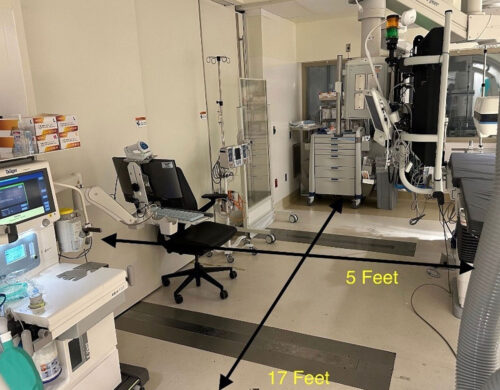
I am writing to suggest it may be appropriate for the ASA/ASPF to specifically address monitoring standards for the provision of sedation, anesthesia, and ventilation of patients in the magnetic resonance imaging (MRI) suite. When I heard Irene P. Osborn, MD, Director (Division of Neuroanesthesia, Mount Sinai Medical Center, NY, NY), speak at the California Society Refresher Course in San Diego earlier this year, I specifically asked if it was appropriate to monitor the patient, not from the scanner room itself (where the patient is in the scanner tube), but from the scanner control room (SCR-the room next door with all controls separated by a wall with a large dark glass window). This question was answered informally by those in attendance, with more than 50% of the attendees (including Dr. Osborn) indicating this was their practice for adult and pediatric patients. I believe this indicated that, typically, NO provider remained in the scanner room itself with the patient—MD or CRNA. I believe this is in contradiction to ASA basic standards for monitoring, which make no provision for such exception. The Standard reads: Qualified anesthesia personnel shall be present in the room throughout the conduct of all general anesthetics, regional anesthetics and monitored anesthesia care. Having had opportunity to practice in multiple private and university settings since my graduation from medical school in 1981, I have seen many developments in providing anesthesia for MRI over the years. Historically, many standard items were not “MRI compatible,” yet were made available in the scanner room with exceptional precautions. Until I came to this university center, I had always remained in the scanner room with my patients under anesthesia and had never seen anesthesia provided from the scanner control room, although this methodology was “standard” at Presbyterian University Hospital in Pittsburgh when I arrived. Here infusion and ventilator tubings were run through wall portholes at distances of 40 feet, and of course, direct monitoring of the patient was not done, but rather the anesthesia machines and telemetric monitor screens in the SCR room were observed. I was for a time, however, able to practice MRI anesthesia from within the scanner room using “non MRI approved” pumps and anesthesia machines maintained at a safe distance from the magnet. In this way, all aspects of anesthetic care could be directly observed and actively managed, as in the operating room and per ASA guidelines. MRI Death Reinforces Precautions This all changed drastically in 2001, when a child died in the Westchester Medical Center in New York State, after being hit in the head in the MRI scanner by a ferromagnetic oxygen cylinder. I was suddenly personally confronted with absolute restrictions prohibiting anything “non-FDA approved MRI compatible” from entering the scanner room. I was suddenly forced out into the SCR with my “magnetic” equipment, monitoring at 40 feet from the SCR, which created great anxiety to apparently only myself. In the past decade, I am aware of 2 deaths having occurred in this city using these “40 foot/next door” techniques: 1) the expiratory limb of a circle system occluded and the patient succumbed to tension pneumothorax, and 2) a mini-drip infusion of propofol (no volumetric pump) ran uncontrolled with a fatal outcome. Astonishingly, a picture of a mini-drip propofol infusion (without volumetric pump) of this kind is pictured, as well as “monitoring from the scanner control room” in a recent MRI-anesthesia review article.1 Incident Illustrates Need for Monitoring More astonishing is that modern MRI suites continue to function with antiquated equipment, although modern and MRI-compatible operating room suites have been introduced in the US and Europe!2,3 Here all anesthetic and surgical needs are met in the scanner room itself. MRI-compatible equipment has now been procured here at my institution, including infusion pumps and MRI ventilators. Anesthesia personnel should now remain in the room, as no biological hazard exists to normal human beings in the scanner room, especially at 10 feet from the magnet coil.4 However, individuals continue, by choice, to monitor from the SCR. This recently led to the following incident:
In conclusion, it would seem appropriate to have specific national standards for MRI anesthesia which meet general published OR guidelines. Education of colleagues regarding the complete lack of danger in the MRI for personnel without metal implants appears necessary, while individuals with contraindications to undergo MRI scanning may need to exclude themselves from work in this area. MRI-compatible equipment can seem very expensive, until the cost of the scanner or patient death puts it into perspective. Equipment chosen by MRI departments may be so foreign to anesthesia personnel (as in this instance) as to present an additional danger due to non-familiarity. Oddly enough, even some of these MRI-approved devices are highly magnetic and non-"MRI-FDA approved devices" have been used safely for years. Modern standards should enhance safer, modern anesthesia techniques and may serve to facilitate the acquisition of appropriate equipment in financially trying times. Anesthesia safety should not be compromised by historic patterns, unfounded fears, or a reluctance to remain at the side of the patient without specifically identified dangers. The separation of anesthesia providers and equipment from the patient’s side in the MRI suite should be relegated to the annals of history.
|