 Articles

| Editors’ Note: This special article is published in full ahead of the October issue of the APSF Newsletter commemorating the 40th anniversary of the founding of APSF. A condensed version appears in the October 2025 APSF Newsletter. |
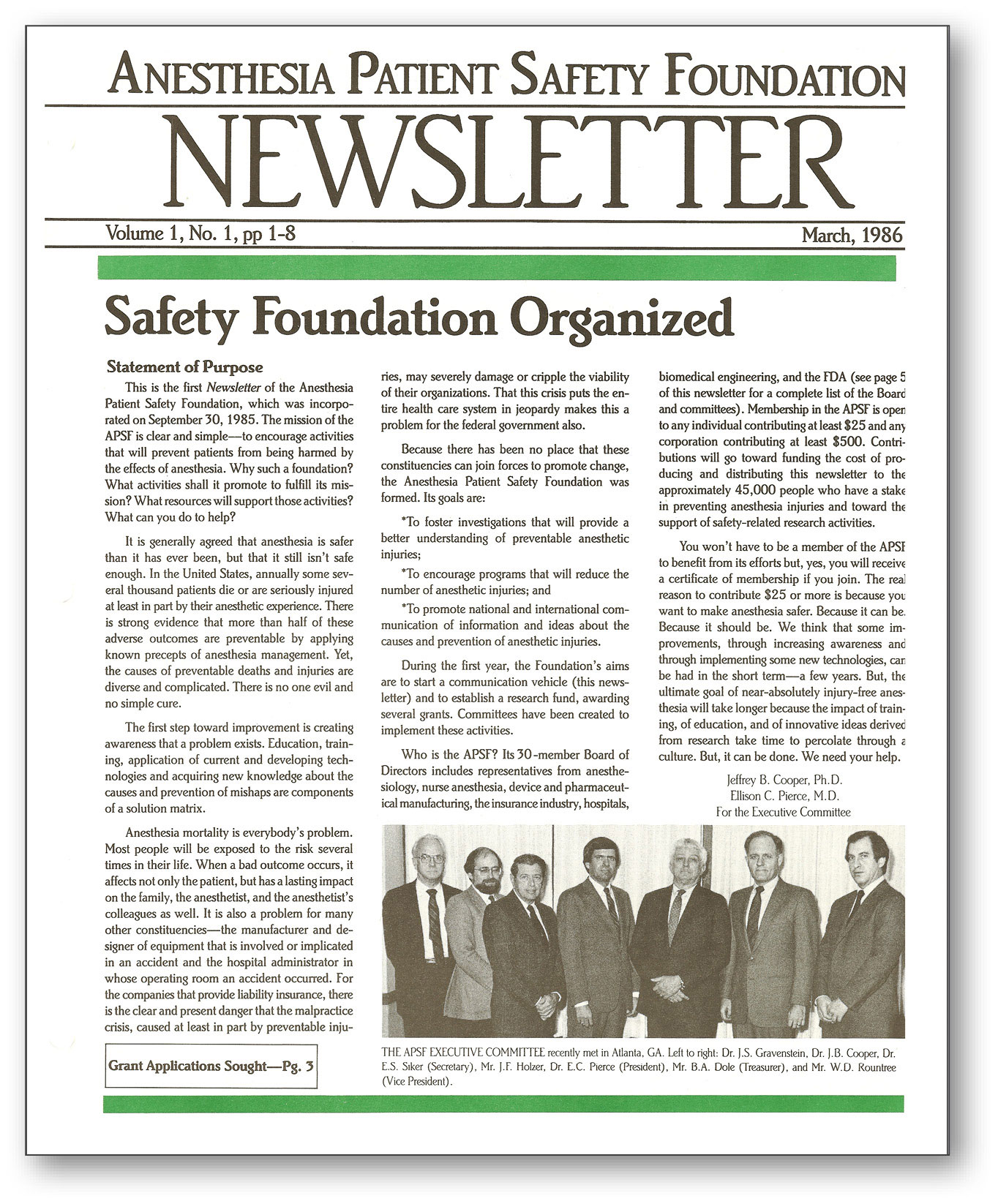
Front page of the first issue of the APSF Newsletter, Vol. 1, No. 1, March 1986, with a photo of the first APSF Executive Committee members.
When the Anesthesia Patient Safety Foundation (APSF) was created in the Fall of 1985, with the admirable mission that “no patient shall be harmed by anesthesia care,” an agenda of communication, education, advocacy, debate, and research support was begun – that continues enthusiastically in force to this day.
The first issue of this APSF Newsletter in March 1986 immediately reflected the efforts of the brand new organization by embracing current issues of that era: essential intraoperative monitoring, risks of hypercarbia vs. hypoxemia, verification of correct endotracheal tube placement, lessons from closed claims, and grant support for much-needed high-quality patient safety research. Some of the early questions and concepts have been resolved or significantly transformed over time – others (many, actually) not so much. Review of every issue of the Newsletter, in order, since its creation reveals that a majority of the main themes of APSF concerns and activities recur over the decades. Note that the “Archives” section of the Newsletter tab on the APSF website is searchable – facilitating retrieval and study of any of a huge number of safety-related topics over the past 40 years, providing an extremely valuable resource for perspective and context and as background to inform new approaches to traditional/classic questions. Also, the modes of APSF communication, outreach, and influence have evolved significantly over the decades, particularly with the advent of the internet, but many of the underlying messages persist. The previous APSF anniversary summary, for the 35th in 2020, was a Newsletter issue reviewing the “10 most important articles” up to that time, as voted by the Editorial Board; importantly, all of them remain relevant today.
Previously published histories have detailed the antecedents, driving forces, and organizational efforts to launch the APSF, as well as its role in establishing, naming, and defining the discipline of patient safety, and as the first formal patient safety organization.1-3 Note that the APSF was prominently cited as the prototypical example of a formal organization helping to improve patient safety in the landmark (and controversial) comprehensive 1999 “To Err Is Human,” report from the Institute of Medicine,4-5 which resulted in an APSF response from then APSF President Robert K. Stoelting, MD (successor to inspirational founding APSF President, the late Ellison C. [“Jeep”] Pierce, Jr., MD) highlighting the significant recognition of APSF, but objecting to the report’s emphasis on identifying and eliminating “unsafe providers,” as opposed to objectively proven system-based protocols and efforts.6
Within the initial year of the APSF, the American Society of Anesthesiologists (ASA) adopted the first ever formal mandatory standards for intraoperative monitoring,7 with the strongest possible backing of the APSF, especially through the involvement and efforts of Dr. Pierce (past ASA President, who initiated its standards committee) and John H. Eichhorn, MD, (then APSF Newsletter Editor, secretary of that new ASA standards committee, and chair of group that created the original Harvard monitoring standards).8 Over its first few years, the APSF supported, endorsed, and publicized both the updating of the ASA standards and the creation and adoption of intraoperative monitoring standards by numerous anesthesia societies and governments from all around the world.

John H. Eichhorn, MD, founding editor and publisher of the APSF Newsletter.
With the intimate involvement of and heavy reliance on technology in anesthesia clinical practice, the APSF has focused on the patient safety impact of equipment-related issues and technology education of anesthesia professionals since the very beginning. The list of specific topics is vast and much too long to list here. “Wrong gas” accidents and management of difficult airways/intubations are examples of recurrent themes throughout the history of the APSF. Interestingly, in the late 1980s, the APSF publicized and helped distribute books published by the two major anesthesia machine manufacturers of that era. At the same time, well before the internet, the APSF (with Dr. Pierce’s initiative and guidance) created and distributed a series of VHS videotapes on a wide variety of patient safety subjects, including many technology questions. The first checklists were endorsed by the APSF. Virtually each issue of the Newsletter over its 40 years featured technical discussions, which have evolved over the years into regular columns about both selected topics (including, still, anesthesia machine function) and question-answer formats, including the current “Rapid Response” section.
One key element of technology applied to anesthesiology involves computerized simulation, which also relates to a perpetual central component of APSF focus and activity – grant support of patient safety research (which was extremely rare prior to 1986, but for which the APSF continues to today to solicit proposals and award grants annually). The first ever grant awarded went in 1986 to David Gaba, MD, of Stanford to use one of the very first realistic mannequin-based simulators in an OR environment, of which he was a principal developer, to study problem-solving strategies in anesthesiology. Additional grants for a variety of simulator research projects followed in subsequent years. Note that the Ellison Pierce Award for the best scientific exhibit at the annual ASA meeting went to many simulation projects of different types for many of the early years of this recognition program. The APSF was under-appreciated and little recognized for being a significant force in helping establish the concept of simulation (now ubiquitous throughout healthcare) as an extremely valuable education, training, and evaluation tool – evidenced, for example, by the APSF’s major role as co-sponsor with the US Food and Drug Administration of a major conference on anesthesia simulator curricula.9 In 1988, Michael Good, MD, of the University of Florida, was awarded a grant to research “Can Simulation Teach Clinical Skills?” That same year, Dr. Gaba received research support in a thematically related area: “A Model Course in Handling lntra-operative Critical Incidents: Training and Practice to Prevent Anesthetic Mishaps.” The full list of research grant topics is long and widely varied. Over the years, there have been periodic summaries in the Newsletter of APSF research grants awarded and the resulting publications and impact.
“Human factors” as a field of study related to anesthesia patient safety has long generated multiple topics of APSF interest. In 1991, the APSF with the FDA organized a major symposium (the first ever) on human error in anesthesia practice.10 Matthew Weinger, MD, for many years an APSF officer and program organizer, is a highly regarded recognized expert on human factors relating to anesthesia safety who received research grant support (e.g., 1996: “Scientific Evaluation of Anesthesiologist Performance: Further Validation and Study of the Effects of Sleep Deprivation and of Intraoperative Reading”) and, among many other things, presented the 2020 annual APSF Ellison C. Pierce, MD, Memorial Lecture at the APSF Annual Meeting: a thought-provoking discussion of “Safety vs. Quality” concerning conflicting approaches to different aspects of healthcare and the application of human factors engineering and human-centered design to help resolve them. A good example of the recurring nature of the issues addressed by the APSF is that in 2016, the annual Stoelting conference concerned again (20 years on) the safety implications of distractions in the OR, yielding a series of recommendations for practice.11 Overall, the topics of distraction (especially “reading” in the OR, which produced for years a torrent of Letters to the Editor in the Newsletter), practitioner fatigue, and, later, OR production pressure (usually with institutional financial motives) have intermittently permeated throughout APSF efforts for decades.
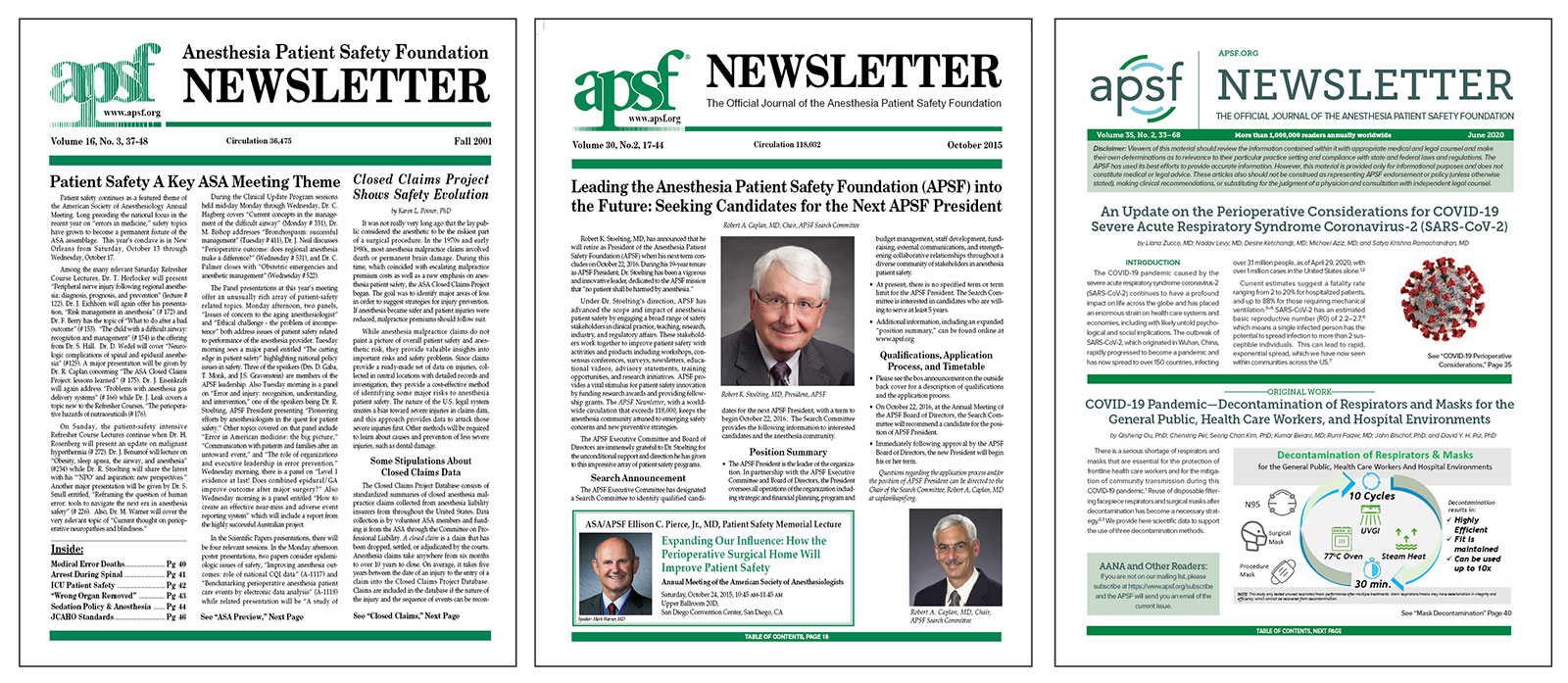
The APSF Newsletter through the years, starting with the original design under John Eichhorn; changes to the logo and format under Bob Morell; and our latest edition with the new branding under Steven Greenberg.
Closely related to human factors in anesthesia patient safety are the topics of crisis management, emergency manuals, cognitive aids for use in clinical practice (both emergency and routine), checklists, and hand-off communications. For example, a 2014 research grant was awarded to study the topic: “The Effect of Technical and Non-Technical Decision Support Tools on Team Performance in Simulated Perioperative Pediatric Crises”.12 The 2014 Pierce Memorial Lecture was presented by Dr. Gaba: “Competence and Teamwork Are Not Enough: The Value of Cognitive Aids.”13 In 2015, the APSF organized a large comprehensive conference “focused on the practical aspects of systematically implementing emergency manuals, cognitive aids, and checklists in the in the perioperative setting.”14 Checklists as a tool to enhance anesthesia safety (and the classic analogy comparing administering anesthesia to piloting a commercial jumbo jet) appeared very early in APSF discussions;15 anesthesia machines and equipment were the first checklist targets.16 The APSF administered a profession-wide survey to help formulate a template for a pre-anesthetic checklist.17 When the World Health Organization (WHO) launched the “WHO Surgical Safety Checklist” as part of its “Safe Surgery Saves Lives” international campaign, the APSF had an integral role in that Jeffrey Cooper, PhD, and John Eichhorn, MD, were members of the 6-person anesthesia working group that helped craft the WHO checklist, which was then strongly endorsed and widely publicized by the APSF.18 Note that the APSF was represented in the World Federated Societies of Anesthesiologists by Dr. Eichhorn, who contributed to and scribed the original 1992 “International Standards for a Safe Practice of Anesthesia”19 and their subsequent revisions,20 all supported and endorsed by the APSF. More recently, proposals for implementation of checklists have focused on handoffs between caregivers. Formed in 2015, the Perioperative Multi-Center Handoff Collaborative is supported by the Anesthesia Patient Safety Foundation.21 The inaugural APSF Stoelting Conference yielded recommended handoff procedures to enhance patient safety.22
Multiple other areas of patient safety interest have received intense APSF efforts over the decades, with illustrations and references too numerous to mention here, but readily available for discovery and study via the Newsletter archives. Good examples include safety issues related to non-OR anesthetizing locations (MRI, cath lab, etc.) and office-based anesthesia. The international focus and communications from the APSF have increased dramatically in recent years, and each issue of the Newsletter is now translated into several languages, significantly increasing the reach and influence of the APSF. Anesthesia automated electronic information systems and their electronic anesthesia records (with debate and mixed opinions about safety implications) have been often considered. Patient-injury fires during monitored anesthesia care with open supplemental oxygen being administered to the sedated patient generated major safety recommendations and is the subject of one of the APSF Executive Summary videos (intended for both professionals and patients) available on the APSF main webpage. Patient vision loss after prolonged prone spine surgery was a critical issue that APSF fixated on first more than 15 years ago and publicized widely, encouraging preventive protocols. This was made the subject of a major APSF 2012 conference23 and yielded another of the APSF highly informative videos on the website. A related extensive concern is the risks of hypotension and adverse events in patients anesthetized in the beach chair position, often for shoulder surgery. This issue surfaced in 2007,24 was the subject of a 2009 APSF Workshop,25 provoked the creation of an APSF registry of injury cases in 2010, and led to several preventive practice recommendations. Monitoring neuromuscular blockade by muscle relaxants during, at the end of, and even after general endotracheal anesthesia has been (and continues to be) a heavily debated issue in and for the APSF. This highlighted the technology for quantitative monitoring26 and contributed to the eventual adoption by the ASA of specific practice guidelines27 to enhance patient safety. Surgical infections was another topic that received significant attention.28-29 The implications and challenges of the COVID-19 pandemic was addressed by the APSF, especially the use of anesthesia machine ventilators in make-shift emergency ICUs set up in operating rooms.
One feature of APSF history that is frequently overlooked is its role in “breaking” news of original discoveries not previously publicized. OR fires due to cautery use with open oxygen delivery to sedated patients has been mentioned, an issue that was previously under-appreciated; the dramatic APSF video was widely circulated and well received, clearly enhancing patient safety. Perhaps the most dramatic example was quite early, with the reports of carbon monoxide poisoning of patients who were almost always the first case of the day, using an anesthesia machine in which the CO2 absorbent (“soda lime”) had become completely dried out to administer a fluorinated hydrocarbon inhalation agent.30 This led to a spate of subsequent discussions, debates, articles, Letters to the Editor, and, eventually, an APSF large consensus conference31 to help clarify and successfully address the issue. Another example of an isolated, but alarming, incident occurred in 1996 and first publicized by the APSF when one of the inhalation anesthetics suffered a manufacturing defect and a dangerously contaminated product32 was distributed, but was promptly recalled.
Probably the most prominent example of a central issue that recurs throughout the history of the APSF is medication safety (syringe swaps, look-alike labels, misidentification, bar codes, pump errors, etc.). Relevant citations are far too many to list here. A 2008 summit meeting prominently involving APSF33 offered insight and recommendations. In 2010, the APSF convened a consensus conference of more than 100 stakeholders from many different backgrounds to develop new strategies for “predictable prompt improvement” in medication safety.34 The 2018 Stoelting Conference was devoted to medication patient safety recommendations.35 Further, the APSF held a panel session titled “Practical Approaches to Improving Medication Safety” at the 2019 ASA Annual Meeting.36 The issue has been more recently paired with opioid medication dangers, especially postoperative ventilatory depression, and improvements have been proposed for both.
Another important element of anesthesia safety promoted by APSF but that may have faded somewhat from prominence in more modern times is the immediate response to an adverse anesthesia event, from the moment a crisis is recognized: the APSF “Adverse Event Protocol.”37 It is still relevant today, and possibly this reminder may encourage anesthesia professionals to save a copy on the computers of their OR anesthesia information systems and their smart phones (the highly debated replacements for the newspapers, magazines, and books in the OR that once generated so much controversy).
Finally, one anesthesia patient safety concept that is the personal favorite of the author and was presented to the APSF in 2023,38 is the relationship of behavior to technology in anesthesia clinical practice. We have a greatly increasing abundance of sophisticated eye-catching technology (artificial intelligence is ever closer), but the final common pathway to optimize safety is always the practitioner human element of best applying that technology to prevent patient injury human errors.
This review highlights many of the issues that have been the focus of APSF efforts over the past 40 years. The APSF has periodically conducted surveys of anesthesia professionals to help determine the relative priorities in order of importance from a list of more than 50 specific patient safety ideas: in 199939 (difficult airway management was number 1); in 201840 (perioperative clinical deterioration and responses topped the list); and in 202141 (“culture of safety, inclusion, and diversity” was the first priority). The ordering of the priorities ranked in the surveys has changed some and progressed over the years, but, as noted, reviewing those lists, most of the fundamental questions persist, thus providing stimulus, inspiration, and direction for APSF engagement in both the present and the future.
John Eichhorn, MD, was the founding editor and publisher of the APSF Newsletter. He lives in San Jose, CA, as a retired professor of Anesthesiology, and continues to serve on the APSF Editorial Board.
The author has no conflicts of interest.
REFERENCES
- Eichhorn JH. The Anesthesia Patient Safety Foundation at 25: a pioneering success insafety; 25th anniversary provokes reflection, anticipation. Anesth Analg 2012;114:791-800. PMID: 22253277.
- Eichhorn JH. The APSF at 25: Pioneering Success in Safety, But Challenges Remain. APSF Newsletter. 2010 (Summer) https://www.apsf.org/article/the-apsf-at-25-pioneering-success-in-safety-but-challenges-remain/ Accessed August 10, 2025.
- Eichhorn JH. The History of Anesthesia Patient Safety. In: Ball C, Bacon D, and Featherstone P (eds,) Broad Horizons – the History of Anesthesia beyond the Operating Room. Int Anesthesiol Clin 2018; 56: 56-93. PMID: 29521790.
- Institute of Medicine (US) Committee on Quality of Health Care in America. To Err is Human:Building a Safer Health System. Washington (DC): National Academies Press (US); 2000. PMID: 25077248.
- Gaba D, Cooper J. Landmark Report Published on Patient Safety. APSF Newsletter. 1999 (Winter). https://www.apsf.org/newsletter/winter-1999/
- Stoelting RK. APSF Responds to IOM Medical Error Report. APSF Newsletter. 2000 (Summer). https://www.apsf.org/article/apsf-responds-to-iom-medical-error-report/ Accessed August 10, 2025.
- Eichhorn JH. ASA Adopts Basic Monitoring Standards. APSF Newsletter. 1987 (Spring). https://www.apsf.org/newsletter/spring-1987/
- Eichhorn JH, Cooper JB, Cullen DJ, Philip JH, Maier WR and Seeman, RG. Standards for patient monitoring during anesthesia at Harvard Medical School. JAMA 1986;256:1017-1020. PMID: 3735628.
- Mellone I. Simulation Takes Washington By Storm. APSF Newsletter. 1989 (Winter). https://www.apsf.org/article/simulation-takes-washington-by-storm/ Accessed August 10, 2025.
- Gaba D, Howard S. Meeting Targets Human Error in Anesthesia. APSF Newsletter. 1991 (Summer). https://www.apsf.org/article/meeting-targets-human-error-in-anesthesia/ Accessed August 10, 2025.
- van Pelt M, Weinger M. Distractions in the Anesthesia Work Environment: Impact on Patient Safety? Report of a Meeting Sponsored by the Anesthesia Patient Safety Foundation. APSF Newsletter. 2017 (October). https://www.apsf.org/article/distractions-in-the-anesthesia-work-environment-impact-on-patient-safety-report-of-a-meeting-sponsored-by-the-anesthesia-patient-safety-foundation/ Accessed August 10, 2025.
- Howard S. Four APSF Grants Awarded for 2014. APSF Newsletter. 2014 (Winter). https://www.apsf.org/article/four-apsf-grants-awarded-for-2014/ Accessed August 10, 2025.
- Chung C, Szokol JW, Weigel WA, Thilen SR. New practice guidelines for neuromuscular blockade. APSF Newsletter. 2023;38:34,39–41. https://www.apsf.org/article/new-practice-guidelines-for-neuromuscular-blockade/ Accessed August 10, 2025.
- Morell RC, Cooper JB. APSF Sponsors Workshop on Implementing Emergency Manuals. APSF Newsletter. 2016 (February). https://www.apsf.org/article/apsf-sponsors-workshop-on-implementing-emergency-manuals/ Accessed August 10, 2025.
- Chopra V. et al. Checklists: Aviation Shows the Way to Safer Anesthesia. APSF Newsletter. 1991 (Fall). https://www.apsf.org/article/checklists-aviation-shows-the-way-to-safer-anesthesia/ Accessed August 10, 2025.
- Good M. Comments Sought on New FDA Preanesthesia Checklist. APSF Newsletter. 1992 (Winter). https://www.apsf.org/article/comments-sought-on-new-fda-preanesthesia-checklist/ Accessed August 10, 2025.
- Stoelting R. APSF Survey Helps To Establish Pre-Induction Checklist. APSF Newsletter. 2013 (Spring-Summer). https://www.apsf.org/article/apsf-survey-helps-to-establish-pre-induction-checklist/ Accessed August 10, 2025.
- APSF. WHO Launches “Safe Surgery Saves Lives.” APSF Newsletter. 2008 (Summer). https://www.apsf.org/article/who-launches-safe-surgery-saves-lives/ Accessed August 10, 2025.
- Gravenstein JS. International Standards for Safe Practice Endorsed by WFSA. APSF Newsletter. 1992 (September). https://www.apsf.org/article/international-standards-for-safe-practice-endorsed-by-wfsa/ Accessed August 10, 2025.
- Merry AF, Cooper JB, Soyannwo O, Wilson IH, Eichhorn JH. International Standards for a Safe Practice of Anesthesia 2010. Can J Anaesth 2010;57:1027–1034.
- Greilich P, Keebler J. Multicenter Handoff Collaborative. APSF Newsletter. 2017 (October). https://www.apsf.org/article/multicenter-handoff-collaborative/ Accessed August 10, 2025.
- Cooper JB, Lane-Fall M, Agarwala A. First Stoelting Conference Reaches Consensus on Many Perioperative Handover Recommendations. APSF Newsletter. 2018 (February). https://www.apsf.org/article/first-stoelting-conference-reaches-consensus-on-many-perioperative-handover-recommendations/ Accessed August 10, 2025.
- Lee L, Stoelting, R. APSF-Sponsored Conference on Perioperative Visual Loss Develops Consensus Conclusions. APSF Newsletter. 2013 (February). https://www.apsf.org/article/apsf-sponsored-conference-on-perioperative-visual-loss-develops-consensus-conclusions/ Accessed August 10, 2025.
- Cullen D, Kirby R. Beach Chair Position May Decrease Cerebral Perfusion. APSF Newsletter. 2007 (June). https://www.apsf.org/article/beach-chair-position-may-decrease-cerebral-perfusion/ Accessed August 10, 2025.
- Lee L, Caplan R. APSF Workshop: Cerebral Perfusion Experts Share Views on Management of Head-Up Cases. APSF Newsletter. 2009 (Winter). https://www.apsf.org/article/apsf-workshop-cerebral-perfusion-experts-share-views-on-management-of-head-up-cases/ Accessed August 10, 2025.
- Renew JR. Advancements in Quantitative Neuromuscular Monitoring. APSF Newsletter. 2021 (October). https://www.apsf.org/article/advancements-in-quantitative-neuromuscular-monitoring/ Accessed August 10, 2025.
- Chung C. et al. New Practice Guidelines for Neuromuscular Blockade. APSF Newsletter. 2023 (June). https://www.apsf.org/article/new-practice-guidelines-for-neuromuscular-blockade/ Accessed August 10, 2025.
- APSF. New Guidance Outlines Recommendations for Infection Control in Anesthesiology. APSF Newsletter. 2018. https://www.apsf.org/news-updates/new-guidance-outlines-recommendations-for-infection-control-in-anesthesiology/ Accessed August 10, 2025.
- Kuvadia M, et al. Designing a Program for Infection Prevention in the Anesthesia Work Environment. APSF Newsletter. 2020. https://www.apsf.org/article/designing-a-program-for-infection-prevention-in-the-anesthesia-work-environment/ Accessed August 10, 2025.
- Moon, R. Carbon Monoxide Gas May Be Linked to CO2 absorbent. APSF Newsletter. 1991 (Spring). https://www.apsf.org/article/carbon-monoxide-gas-may-be-linked-to-co2-absorbent/ Accessed August 10, 2025.
- Olympio M. Carbon Dioxide Absorbent Desiccation Safety Conference Convened by APSF. APSF Newsletter. 2005 (Summer). https://www.apsf.org/article/carbon-dioxide-absorbent-desiccation-safety-conference-convened-by-apsf/ Accessed August 10, 2025.
- Leary J. Contaminated Sevoflurane Use Reported from NY State. APSF Newsletter. 1996 (Winter). https://www.apsf.org/article/contaminated-sevoflurane-use-reported-from-ny-state/ Accessed August 10, 2025.
- Martin D. Medication Errors Persist. APSF Newsletter. 2008 (Fall). https://www.apsf.org/article/medication-errors-persist/ Accessed August 10, 2025.
- Eichhorn J. APSF Hosts Medication Safety Conference. APSF Newsletter. 2010 (Spring). https://www.apsf.org/article/apsf-hosts-medication-safety-conference/ Accessed August 10, 2025.
- APSF. APSF Stoelting Conference 2018. APSF Newsletter. 2018. https://www.apsf.org/event/apsf-stoelting-conference-2018/ Accessed August 10, 2025.
- Beard J. APSF-Sponsored 2019 ASA Panel on “Practical Approaches to Improving Medication Safety.” APSF Newsletter. 2020 (February). https://www.apsf.org/article/apsf-sponsored-2019-asa-panel-on-practical-approaches-to-improving-medication-safety/ Accessed August 10, 2025.
- Eichhorn J. Organized Response to Major Anesthesia Accident Will Help Limit Damage. APSF Newsletter. 2006 (March). https://www.apsf.org/article/organized-response-to-major-anesthesia-accident-will-help-limit-damage/ Accessed August 10, 2025.
- Eichhorn JH. “Safey monitoring” behavior and technology: Reflections from the Anesthesia Patient Safety Foundation 2023 E.C. Pierce, MD, Memorial Lecture. Anesthesia and Analgesia 2025;140:213-219. [ https://www.apsf.org/asa-apsf-ellison-c-pierce-jr-md-memorial-lecturers/ ]
- Stoelting R. APSF Survey Results Identify Safety Issues Priorities. APSF Newsletter. 1999 (Spring). https://www.apsf.org/article/apsf-survey-results-identify-safety-issues-priorities/ Accessed August 10, 2025.
- Lane-Fall M. APSF Highlights 12 Perioperative Patient Safety Priorities for 2018. APSF Newsletter. 2018 (October). https://www.apsf.org/article/apsf-highlights-12-perioperative-patient-safety-priorities-for-2018/ Accessed August 10, 2025.
- Greenberg S. The APSF Revisits Its Top 10 Patient Safety Priorities. APSF Newsletter. 2021 (June). https://www.apsf.org/article/the-apsf-revisits-its-top-10-patient-safety-priorities/ Accessed August 10, 2025.