

 Issue PDF
I would like to report the sudden inability to provide manual positive pressure ventilation while using a Dräger Fabius GS anesthesia machine (Dräger, Lubeck, Germany). After completion of the anesthesia check-out procedure a patient was brought into the room for induction of general anesthesia. Monitors were applied and the patient was given an induction dose of anesthesia. Ventilation was confirmed, the patient was paralyzed, and his trachea intubated. After intubation the patient could not be ventilated. The anesthesia circuit connection was checked for a disconnect, but none was found. An ambu bag was obtained and the patient ventilated while the anesthesia machine was checked out. The temperature monitoring wire that was moved after induction in anticipation of the placement of an esophageal temperature probe was seen lodged under the APL valve (see Figures 1 and 2). The wire was easily removed from under the valve and the system was then able to generate positive pressure ventilation in the manual mode. This is a potentially dangerous problem that can be easily remedied, but many anesthesiologists may not think that a closed working APL valve functioning a minute ago could be the cause of the inability to generate positive pressure ventilation.
A literature search found several case reports of this same event happening with the gas sampling line of other Dräger anesthesia machines.1-4 Dräger representatives have commented twice in letter form that the APL valve should be clear of wires and tubing.5,6 Although ideal, in clinical situations that is often difficult to obtain. Does Dräger have an upgrade available for the Fabius GS that would solve this problem?
Sincerely,
Scott Groudine, MD
Professor of Anesthesiology
Albany Medical Center
Albany, NY 12110
Reply:
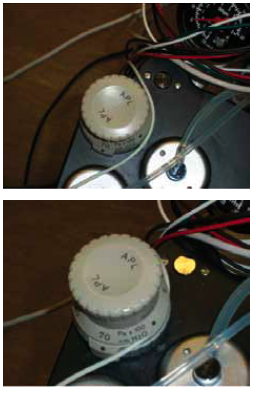
Figures 1 and 2: Temperature wires for esophageal temperature probe lodged under APL valve prevent full closure and ability to generate positive pressure for manual ventilation.
Thank you, Dr. Groudine, for your question. All new Apollo anesthesia machines (purchased since March 2009) and Fabius Family anesthesia machines (purchased since September 2009) have incorporated a design enhancement to the APL valve that reduces the potential of the problem discussed above. For those customers with Apollo or Fabius machines utilizing the older APL valve design, an upgrade is available. Please contact Dräger’s Triage Center at 1-800-4-DRAGER for more information.
Thank you,
David Karchner
Director of Marketing, Perioperative Care
Dräger Medical Inc.
3135 Quarry Road, Telford, PA 18969
References
- Hennenfent S, Suslowicz B. Circuit leak from capnograph sampling line lodged under adjustable pressure limiting valve. Anesth Analg 2010;111:578.
- Robards C, Corda D. A potential hazard involving the gas sampling line and the adjustable pressure limiting valve on the Drager Apollo Anesthesia Workstation. Anesth Analg 2010;111:578-9.
- Vijayakumar A, Saxena DK, Sivan Pillay A, Darsow R. Massive leak during manual ventilation: adjustable pressure limiting valve malfunction not detected by pre-anesthetic checkout. Anesth Analg 2010;111:579-80.
- Kibelbek MJ. Cable trapped under Dräger Fabius automatic pressure limiting valve causes inability to ventilate. Anesthesiology 2007;106:639-40.
- Clark RM. In reply. Anesthesiology 2007;106:640.
- Karchner D. In response. Anesth Analg 2010;111:580.