

 Issue PDF
To the Editor
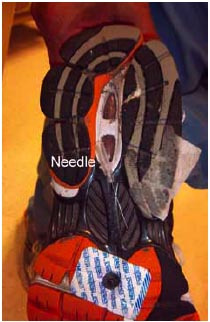
Figure 1. The stylet (Needle) is noted in the sole of the shoe.
Operating room personnel are at risk for needlestick injuries and consequently blood acquired infections.1 Anesthesia personnel use all kind of needle devices (safety and non-safety intravenous catheters and hollow needles) and are cautious during the cannulation of a vein and artery. They are also are educated about discarding the stylet of the intravenous catheter in a box for sharp objects. Recently, an anesthesiologist provided services in 3 operating rooms. He washed his hand between each room. After leaving the last room, he felt “something” under his shoe (Figure 1). Besides some tape and an electrocardiographic lead, there was also a non-safety intravenous catheter stylet attached to the sole of the shoe. Perhaps operating room personnel should also check their shoes between rooms and use intravenous catheters with safety measures designed to reduce the incidence of needle sticks.
Alfonso Casta, MD
Boston, MA 02115
Reference
- Myers DJ, Epling C, Dement J, Hunt D. Risk of sharp device-related blood and body fluid exposure in operating rooms. Infect Control Hosp Epidemiol 2008;29:1139-48.