
 PDF
PDFNearly half of older surgical patients have unrecognized cognitive impairment, a major risk factor for postoperative delirium and other perioperative neurocognitive disorders . Despite strong recommendations from major medical societies, routine preoperative cognitive screening remains uncommon in anesthesia practice. As a result, cognitive vulnerability often goes undetected, limiting opportunities to tailor perioperative care and reduce preventable complications. This article highlights the gap between evidence and practice and calls for institutional leadership, standardized screening pathways, and integrated workflows to make cognitive screening a routine component of care for older surgical patients.
INTRODUCTION
Unrecognized cognitive impairment affects an estimated 37–50% of older surgical patients and is a major risk factor for perioperative neurocognitive disorders.1 These disorders affect up to 50% of older surgical patients and contribute to prolonged hospitalization, increased mortality, accelerated cognitive decline, and billions in annual healthcare costs.2 Despite strong recommendations supporting preoperative cognitive screening,3–5 adoption remains limited. A recent multicenter analysis of more than 900,000 surgical patients documented cognitive screening in fewer than 1% of relevant cases and delirium screening in only 13.6%.6 To better understand current attitudes and barriers among anesthesia professionals engaged with the Anesthesia Patient Safety Foundation (APSF), we conducted a brief member survey on preoperative cognitive assessment practices.
THE APSF SURVEY: WHAT MEMBERS TOLD US
In September–October 2025, the APSF Patient Safety Priority Advisory Group created and distributed an anonymous 11-item electronic survey to 205 APSF board and committee members. Of the 113 respondents (55% response rate), 94.7% identified as clinicians; the remaining six were APSF members in nonclinical roles (administrators, researchers, and industry representatives) and are included in the overall summary below. Practice-level questions were answered by 80 respondents who completed those items. Most respondents practiced in the United States (97.5%), with anesthesiologists comprising 57.5%; the remainder included certified registered nurse anesthetists, anesthesiologist assistants, students and trainees, and perioperative nurses.
Importance is rated high, but practice lags far behind
Nearly two-thirds of respondents (65%) rated preoperative cognitive screening as “very” or “extremely” important for patient safety and outcomes, with an additional 28.8% considering it “moderately” important. Only 5% viewed screening as having little or no importance. Despite this strong endorsement, routine screening remains rare (Figure 1). Among the 33 respondents who did screen, the most commonly used tools were the Mini-Cog (33.3%) and the Montreal Cognitive Assessment (MoCA, 33.3%), followed by the Sweet 16 (12.1%) and the Mini-Mental State Examination (MMSE, 9.1%).
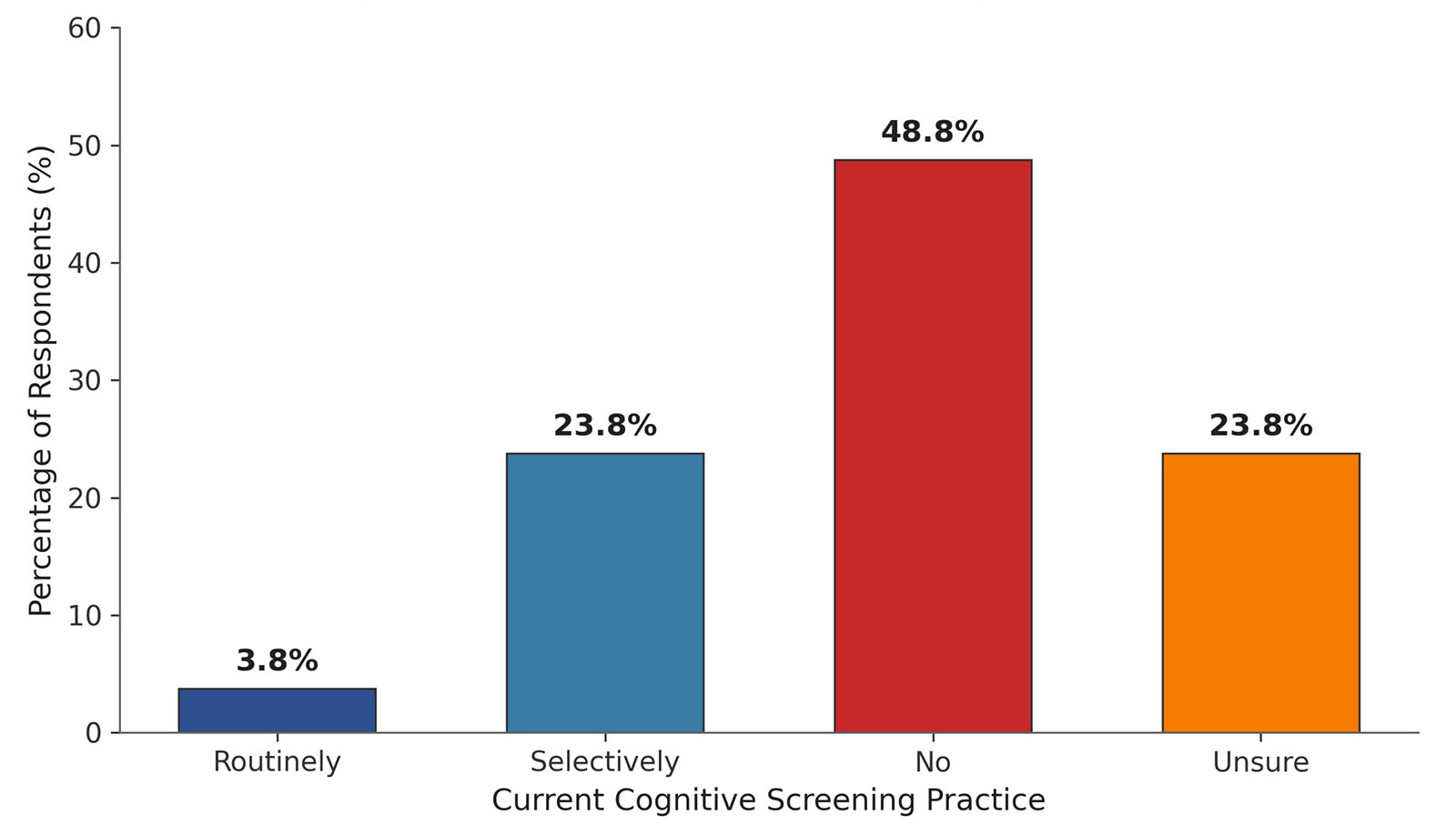
Figure 1. Current preoperative cognitive screening practices among APSF survey respondents (n=80). Bar chart showing the distribution of self-reported screening practices: routine screening of all eligible older patients (3.8%), selective screening based on clinical suspicion (23.8%), no current screening (48.8%), and unsure about institutional practices (23.8%).
Demand for resources and training
When asked what would most help implementation, respondents prioritized standardized protocols and guidelines, electronic health record integration, outcome data demonstrating impact, and training programs. Most respondents expressed interest in additional training on cognitive screening tools.
THE KNOWLEDGE-PRACTICE GAP
These findings reveal a striking disconnect. Anesthesia professionals engaged with the APSF clearly understand that cognitive impairment matters; 65% rate screening as very or extremely important. Yet only 27.5% perform any screening at all, and routine assessment of every eligible older patient occurs in fewer than 4% of practices. Because the survey reached APSF board and committee members, a group with an unusually active interest in perioperative patient safety, the level of engagement reported here likely exceeds what would be observed in the broader anesthesia community. The true implementation gap is therefore probably wider than these figures suggest.
Respondents identified clear, structural reasons for this gap and cited a variety of barriers (Table 1). The consequences of failing to perform cognitive assessment fall disproportionately on older patients. Without baseline cognitive assessment, subtle impairment goes unrecognized, care plans proceed without appropriate modifications, and delirium, the most common perioperative neurocognitive disorder and often preventable, may develop and remain undetected until complications emerge.
Table 1. Barriers to Preoperative Cognitive Screening Reported by Respondents Who Do Not Routinely Screen All Eligible Older Patients (n=66; respondents could select multiple barriers).
| Barrier | Respondents reporting n (%)* |
| Absence of institutional support or protocols | 32 (48.5%) |
| Insufficient time during preoperative evaluation | 26 (39.4%) |
| Lack of resources or staffing | 25 (37.9%) |
| Insufficient training on screening tools | 20 (30.3%) |
| Uncertainty about what to do with a positive screen | 20 (30.3%) |
| Uncertainty about clinical utility of screening | 13 (19.7%) |
| Patient or family concerns | 2 (3%) |
| *Of the 80 respondents who completed the practice-level survey items, 66 answered the barriers question; percentages reported in this table are calculated using 66 as the denominator. | |
WHAT COGNITIVE SCREENING ACTUALLY MEASURES
Effective cognitive assessment evaluates multiple domains that directly affect perioperative safety, including memory, visuospatial skills, orientation, attention, language, praxis, and executive function. Brief screening tools such as the Mini-Cog can assess several of these domains in fewer than three minutes. The goal is not to make a diagnosis but to identify patients who would benefit from modified perioperative care, enhanced monitoring, or referral for formal cognitive evaluation. Commonly used screening tools differ in length, cost, sensitivity, and the domains they assess (Table 2).
Table 2. Comparison of Common Preoperative Cognitive Screening Tools.
| Mini-Cog | MoCA | Sweet 16 | MMSE | |
| Time to test | 2–4 min | 10–15 min | 2–3 min | 7–10 min |
| Cost | Free | Free | Free | Paid license |
| Sensitivity | Moderate | Highest | High | Moderate |
| Components | 3-word recall; clock draw | Executive, visuospatial, memory, attention | Orientation, recall, digit span | Orientation, recall, attention, language |
| Abbreviations: Mini-Cog, Mini-Cognitive Assessment Instrument; MoCA, Montreal Cognitive Assessment; Sweet 16, Sweet 16 cognitive screen; MMSE, Mini-Mental State Examination. | ||||
| Mini-Cog | |
| Time to test | 2–4 min |
| Cost | Free |
| Sensitivity | Moderate |
| Components | 3-word recall; clock draw |
| MoCA | |
| Time to test | 10–15 min |
| Cost | Free |
| Sensitivity | Highest |
| Components | Executive, visuospatial, memory, attention |
| Sweet 16 | |
| Time to test | 2–3 min |
| Cost | Free |
| Sensitivity | High |
| Components | Orientation, recall, digit span |
| MMSE | |
| Time to test | 7–10 min |
| Cost | Paid license |
| Sensitivity | Moderate |
| Components | Orientation, recall, attention, language |
| Abbreviations: Mini-Cog, Mini-Cognitive Assessment Instrument; MoCA, Montreal Cognitive Assessment; Sweet 16, Sweet 16 cognitive screen; MMSE, Mini-Mental State Examination. | |
WHY INSTITUTIONS MUST LEAD
The survey results make clear that individual clinician initiative alone cannot solve this problem. When nearly half of respondents cite the absence of institutional protocols as a barrier, the solution must be institutional. Successful implementation requires deliberate organizational commitment, including the following:
- Designating responsibility for screening within the perioperative workflow
- Integrating cognitive assessment into preoperative clinic and day-of-surgery processes
- Providing training in tool selection and interpretation
- Building electronic health record (EHR) documentation and decision-support tools
- Establishing clear pathways for acting on positive screens.
Without these structures, even motivated clinicians face an uphill battle against time pressure and competing demands. The strong respondent interest in standardized protocols and EHR integration reflects this need for clear, supported workflows. Health care systems that have implemented routine cognitive screening have reported high compliance rates and clinician acceptance once workflows are established.7
IMPLICATIONS FOR PATIENT SAFETY
Unrecognized cognitive impairment is a genuine safety hazard. Patients with baseline deficits face elevated risks of falls, delirium, difficulty with medication self-management after discharge, and other adverse discharge outcomes. Informed consent may be compromised when decision-making capacity is assumed rather than assessed, and communication failures multiply when cognitive limitations go unacknowledged.
Conversely, early identification enables targeted, evidence-based interventions: simplified communication, family involvement in care planning, multicomponent delirium-prevention protocols, appropriate discharge planning, and realistic expectation-setting. Multicomponent nonpharmacologic delirium-prevention programs have been shown in meta-analyses and consensus guidelines to reduce postoperative delirium incidence and falls and to improve recovery in older surgical patients.8,9 Routine cognitive screening has been successfully implemented in diverse settings; one academic medical center reported that 21% of older surgical patients screened positive on the Mini-Cog, rising to 36% in those older than 85 years, and that providers blinded to screening results failed to identify cognitive impairment in half of affected patients, underscoring the need for formal, validated screening to ensure reliable identification.10
The APSF has long championed systematic approaches to patient safety. Routine preoperative cognitive assessment identifies risk before harm occurs, enabling prevention rather than reaction and building reliable systems that do not depend on individual vigilance alone.
A PATH FORWARD
The survey findings should prompt reflection and action. Closing the gap between recognition and routine practice will require sustained organizational commitment to systematic cognitive screening. Future APSF initiatives will focus on developing practical resources to help institutions screen at-risk patients and implement protocols to prevent perioperative neurocognitive disorders.
Recognition of brain health as a perioperative priority has gained important momentum. The American Society of Anesthesiologists (ASA) launched the Perioperative Brain Health Initiative under the direction of Drs. Lee Fleisher and Daniel Cole. This initiative provides educational resources designed to help anesthesia teams identify older patients vulnerable to perioperative neurocognitive disorders and to implement evidence-based perioperative strategies, from preoperative assessment through postoperative recovery, which protect cognitive function (https://www.asahq.org/brainhealthinitiative/about).
The APSF Brain Health Advisory Group is partnering with the ASA to develop best practices for identifying preoperative cognitive decline and implementing evidence-based interventions to prevent perioperative neurocognitive disorders. Drawing on published literature and institutional experience, the APSF Brain Health Implementation Task Force is preparing a comprehensive protocol that addresses the rationale for preoperative screening, describes available screening tools with recommendations matched to institutional capabilities, outlines intraoperative and postoperative strategies to prevent perioperative neurocognitive disorders, and offers approaches to improve outcomes when impairment is identified. As the surgical population ages, it is essential that we identify older adults at risk for cognitive decline, and act on what we find.
Valluvan Rangasamy, MD, MPH, is an attending anesthesiologist in the Department of Anesthesia, Critical Care, and Pain Medicine at Beth Israel Deaconess Medical Center, and an instructor in anesthesia at Harvard Medical School, Boston, MA.
Lena Scotto, MD, is an attending anesthesiologist in the Department of Anesthesiology, Perioperative and Pain Medicine at the VA Palo Alto Health Care System and Stanford University School of Medicine, Palo Alto, CA.
Vanessa Moll, MD, PhD, is an associate professor in the Department of Anesthesiology, Division of Critical Care Medicine, at the University of Minnesota, Minneapolis, MN.
Jeffrey Huang, MD, is a senior member in the Department of Anesthesiology and Critical Care at Moffitt Cancer Center and professor of oncological science at the University of South Florida Morsani College of Medicine, Tampa, FL. He serves as co-chair of the APSF Brain Health Advisory Group and is a member of the APSF Committee on Education and Training.
The authors report no conflicts of interest related to this work.
Acknowledgments: We gratefully acknowledge Drs. Daniel Cole and Steven Greenberg for their thoughtful review of this manuscript. Their constructive feedback was invaluable in refining the final version. We also thank the members of the APSF Brain Health Advisory Group and APSF leadership for their continued support and guidance.
Authors’ note: The Sweet 16 was originally published as a brief, validated cognitive screening instrument and was described by its developers as open access. Its reported administration time of approximately 2–3 minutes, minimal training requirements, and lack of need for special materials made it an attractive and practical option for cognitive screening in busy clinical settings. However, following its publication, the instrument was withdrawn from dissemination after an intellectual-property dispute involving the MMSE. Its inclusion in this article reflects the peer-reviewed scientific literature and its reported clinical utility at the time of publication. Readers considering cognitive screening tools should be aware that the Sweet 16 is no longer routinely available for dissemination and should confirm current availability and applicable permissions before considering its use.
REFERENCES
- Kapoor P, Chen L, Saripella A, et al. Prevalence of preoperative cognitive impairment in older surgical patients: a systematic review and meta-analysis. J Clin Anesth. 2022;76:110574. PMID 34749047.
- Chan LK, Chuan A, Berney CR, Chan DK. Routine cognitive screening for older people undergoing major elective surgery: benefits, risks and costs. Anaesth Intensive Care. 2024;52:275–282. PMID 39212187.
- Chow WB, Rosenthal RA, Merkow RP, et al; American College of Surgeons National Surgical Quality Improvement Program; American Geriatrics Society. Optimal preoperative assessment of the geriatric surgical patient: a best practices guideline from the American College of Surgeons National Surgical Quality Improvement Program and the American Geriatrics Society. J Am Coll Surg. 2012;215:453–466. PMID 22917646.
- Arias F, Wiggins M, Urman RD, et al. Rapid in-person cognitive screening in the preoperative setting: test considerations and recommendations from the Society for Perioperative Assessment and Quality Improvement (SPAQI). Perioper Care Oper Room Manag. 2020;19:100089. PMID 32342018.
- Sieber F, McIsaac DI, Deiner S, et al. 2025 American Society of Anesthesiologists Practice Advisory for perioperative care of older adults scheduled for inpatient surgery. Anesthesiology. 2025;142:22–51. PMID 39655991.
- Abess AT, Shah NJ, Whitlock EL, et al; MPOG Collaborators. Brain health screening in older surgical patients: a multicenter, retrospective, observational analysis and survey. Anesth Analg. 2025;141:1097–1106. PMID 40378079.
- Borson S, Scanlan J, Hummel J, et al. Implementing routine cognitive screening of older adults in primary care: process and impact on physician behavior. J Gen Intern Med. 2007;22:811–817. PMID 17447100.
- Hshieh TT, Yue J, Oh E, et al. Effectiveness of multicomponent nonpharmacological delirium interventions: a meta-analysis. JAMA Intern Med. 2015;175:512–520. PMID 25643002.
- Aldecoa C, Bettelli G, Bilotta F, et al. Update of the European Society of Anaesthesiology and Intensive Care Medicine evidence-based and consensus-based guideline on postoperative delirium in adult patients. Eur J Anaesthesiol. 2024;41:81–108. PMID 37599617.
- Decker J, Kaloostian CL, Gurvich, et al. Beyond cognitive screening: establishing an interprofessional perioperative brain health initiative. J Am Geriatr Soc. 2020;68:2359–2364. PMID 32748487.