Episode #331 Safer Under Pressure
November 4, 2026
Welcome to the next installment of the Anesthesia Patient Safety podcast hosted by Alli Bechtel. This podcast will be an exciting journey towards improved anesthesia patient safety.
This is the fifth and final episode in our series on the 2026 APSF Stoelting Conference.
Our first featured talk is “Anchoring Note: Safety in Motion – How Teams Adapt When Best Practice Isn’t Possible” by Charles Vincent.
Our next round of talks focuses on the AXIOM: Recovery is a Trajectory to be Verified, Not Assumed. The moderator is Brent Dunworth. The first talk is Dynamic Monitoring using a Control Tower by Michael Scott. Then we turned our attention to Professor Guy Ludbrook’s talk, “Enhanced PostOperative Care unites EPOC.” The final talk in this session is “Continuous Monitoring of Hospitalized Patients in a Community Health Network” by Christopher R. Roscher. Don’t forget you can check out all of these talks on YouTube. Check it out here: https://www.apsf.org/event/stoelting-2026/
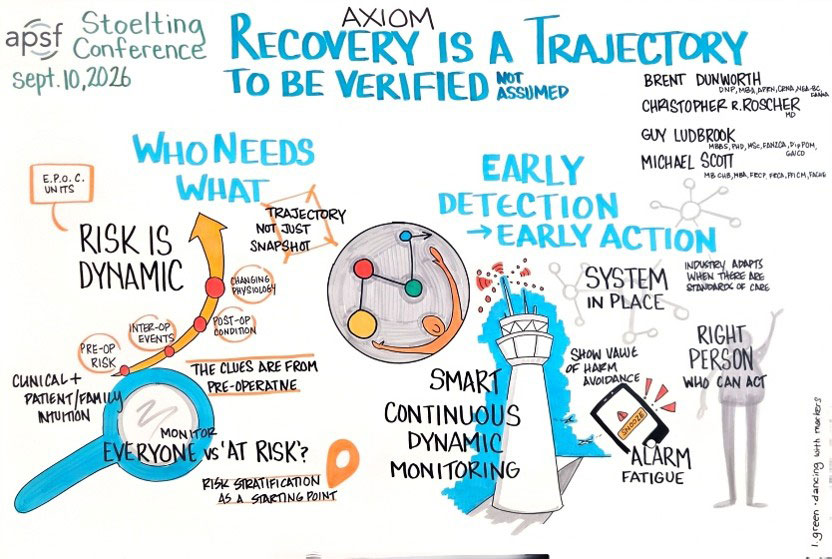
Here are the visual notes for some of the talks today:
Here are the citations that we talked about on the show today:
- Amalberti R, Vincent C. Managing risk in hazardous conditions: improvisation is not enough. BMJ Qual Saf. 2020 Jan;29(1):60-63. doi: 10.1136/bmjqs-2019-009443. Epub 2019 Jul 9. PMID: 31289111; PMCID: PMC6934236.
- Page B, Irving D, Amalberti R, Vincent C. Health services under pressure: a scoping review and development of a taxonomy of adaptive strategies. BMJ Qual Saf. 2024 Oct 18;33(11):738-747. doi: 10.1136/bmjqs-2023-016686. PMID: 38050158; PMCID: PMC11503202.
- APSF Book Club Recommendation: Safer Healthcare: Strategies for the Real World
- Scott MJ; APSF Hemodynamic Instability Writing Group. Perioperative Patients With Hemodynamic Instability: Consensus Recommendations of the Anesthesia Patient Safety Foundation. Anesth Analg. 2024 Apr 1;138(4):713-724. doi: 10.1213/ANE.0000000000006789. Epub 2023 Dec 28. Erratum in: Anesth Analg. 2025 Feb 01;140(2):e18. doi: 10.1213/ANE.0000000000007300. PMID: 38153876; PMCID: PMC10916753.
This episode was edited and produced by Mike Chan.
Subscribe to our YouTube Channel here: https://www.youtube.com/@AnesthesiaPatientSafety
Be sure to check out the APSF website at https://www.apsf.org/
Make sure that you subscribe to our newsletter at https://www.apsf.org/subscribe/
Follow us on Twitter @APSForg
Questions or Comments? Email me at podcast@apsf.org.
Thank you to our individual supports https://www.apsf.org/product/donation-individual/
Be a part of our first crowdfunding campaign https://www.apsf.org/product/crowdfunding-donation/
Thank you to our corporate supporters https://www.apsf.org/donate/corporate-and-community-donors/
Additional sound effects from: Zapsplat.
© 2026, The Anesthesia Patient Safety Foundation
Opening Clip: [Charles Vincent] “Just a little preamble. I suppose in the early days of safety we thought more about improving safety by making things more reliable, doing things properly, and um, you know, whether it’s hand washing or patient identification or whatever it might be. And nowadays we perhaps at least I certainly think a bit more about a balance between being reliable, being rigid, being standardized, and a certain amount of necessary adaptation. And also quite a lot of the time, a lot of unnecessary adaptation. And as you all know better than me, the clinical work is a mixture in anesthesia, as Helen has often stressed to me, between following the rules and being very rigid and standardized about some things, but always adapting as needed to the needs of patients or certain circumstances and pressures. And having to be quite fluid and dynamic, if you like, at some times.”
This is the Anesthesia Patient Safety Podcast and I’m your host, Alli Bechtel. We are wrapping up our coverage of the 2026 APSF Stoelting Conference today. This year’s conference was “SOS!: Signals of Safety… Safely across the Patient’s Perioperative Journey.” This is a 5-part series and we hope that you will check out the entire series.
Before we dive further into the episode today, we’d like to recognize Fresenius Kabi, a major corporate supporter of APSF. Fresenius Kabi has generously provided unrestricted support to further our vision that “no one shall be harmed by anesthesia care”. Thank you, Fresenius Kabi, – we wouldn’t be able to do all that we do without you!”
Day 2 of the conference opened with us talking about thinking differently and I’m going to challenge you to think differently, just as Della Lin challenged us to do. Della is the chair of this year’s Stoelting Conference and practices anesthesia in Hawaii. She has a commitment to patient safety, and her work includes facilitating multi-stakeholder groups to challenge and better the status quo of patient care systems through shared goals of improving safety culture, effective leadership and building sustainable solutions from the ground level.
So, let’s think differently when it comes to seeing our patients safely through the peri-operative journey.
Our first speakers for Day 2 are Dr. Charles Vincent, professor of Psychology at the University of Oxford and his talk, “Managing risk under pressure: strategies for the short and long term.” Helen Higham is the director of OxSTar at the University of Oxford and presents as well.
We are asking a lot of big questions during this conference series, so let’s start off with another couple…What are we doing when we are under pressure and can we adapt better?
Perhaps, the idea of resilience came to mind. Resilience has become a almost a buzzword these days for work under pressure and adapting, but Charles cautions us that it may not be the answer to everything, but just another contributing factor.
When we step back and think about designing safer healthcare systems, this is quite a difficult undertaking. There is no simple answer here.
We are adding another book recommendation to the APSF Book Club list. It is Safer Healthcare: Strategies for the Real World. We hope that you will check it out and I will put the citation in the show notes. The authors attempt to tackle some more difficult questions:
- How are safety and quality achieved in different settings?
- What interventions can be used to improve safety?
- Is there a framework of strategies and interventions that can be developed and applied widely?
What if we think about safety in healthcare by examining 3 different models of safety: safety in aviation, safety when it comes to firefighters, this is more team based, and finally deep-sea fishing which is one of the most dangerous careers, but the experts in this area want to be safe despite the challenging conditions. Healthcare probably touches each of these models at different times. Anesthesia has lots of similarities to aviation, perioperative team need to excel at teamwork like fire fighters, and during covid, healthcare was more like deep sea fishing when there was a lot of personal safety risk involved.
Now, let’s talk about the things that we can do to improve patient safety on a longer time horizon and more immediately. Longer term safety interventions may include optimizing and risk management strategies. Optimizing strategies involve following best practices and improving the system while risk management strategies involves risk control, adaptation and response, and mitigation.
Charles offers several short-term solutions…that anesthesia professionals may find particularly useful.
Improvision is not enough. Can we adapt and react and not just improvise going forward?
Rather than just thinking about resilience, another strategy is to think about pressure and strategies. The first question is What are the pressures? Perhaps, it is a staff skill-mix mismatch for example.
This leads to a conceptual framework with wider contextual pressures and then to anticipatory strategies and on-the-day adaptations. For example, wider conceptual pressures may include pressure in the ICU and surgery with demand exceeding capacity leading to difficult working conditions and ultimately problems with the system functioning. This conceptual framework allows you to map out the pressures and how the system changes due to these pressures.
Then, for anticipatory strategies these might include increasing resources, controlling demand, and plans for managing workload. More specific examples include improving the skill mix or changing the discharge protocol. These are things that you can do in advance to help meet the pressures on the system.
On the day adaptations may include flexing resources, prioritizing demand, and adapting ways of working. Examples here include task-shifting, temporary stopping activities, and more huddles/team communication to allow the teams to quickly react and adjust. This is what smart and efficient teams do.
Let’s look at an some examples of on the day adaptations. You are probably familiar with these concepts from your clinical experience. It may involve flexing staff or flexing space and beds. And this may look like staff working late to complete the clinical work or managers needing to take on clinical responsibility. This is flexing staff. Alternately, creating temporary holding areas for patients or transferring patients based on needs is an example of adapting by flexing space and beds to meet the clinical demand on the day.
Let’s take a listen as Charles shares some guiding principles when it comes to meeting demands under pressure:
[Charles Vincent] “Okay, let’s map up pressures. And what strategies do we currently use? Because people will be doing a lot of things that are not shared and they’re certainly not planned or agreed. And by then developing a, if you like, a local menu of options, one could build to move to a point of actually implementing a set of strategies on a tough day and saying, this is the way we shift things when we’re really under pressure. And the great advantage of that also is that you shift back again when that time is over, and therefore you can kind of maintain standards and set limits and time limits. Just in terms of the sort of softer side of it, if you like, is a few principles. It’s going to be much safer. And I think this is particularly true at the executive level to openly discuss and just sort of say we know you have to cut corners under pressure. What we’ve got to talk about is not, you know, not just saying when you shouldn’t be doing that, but saying, well, which corners are we’re gonna cut and how, and how we’re gonna coordinate this, and how we’re gonna keep patients safe, even though we know we can’t give a hundred percent service today. And this is the most critical point that I’ve said several times. I think coordinated approach to adaptations and shifting things is a lot safer than hidden adaptations are the most dangerous when you don’t know that things aren’t being done.”
[Bechtel] As we wrap up this talk, here are some important considerations that we may be able to use when our system is under pressure. These include:
- Acknowledge and communicate openly when standards cannot be met
- Allow and encourage adaptations that are explicit, shared, monitored. Making it explicit is really important here to incorporate it into training and think about how we respond to pressures.
- A coordinated approach to adaptation will be safer than hidden individual and team adaptations.
- Adaptations are not forever. When the system is no longer under pressure, then you no longer need these adaptations.
- Define the no-go zones. These are things that must happen no matter what.
Going forward, more research is needed in this area. Our systems are going to continue to come under pressure, but this is a practical framework for thinking about this and how we can respond and adapt while maintaining patient safety.
Speaking of systems under pressure, we experienced significant pressure during the covid pandemic. What did we learn from that experience and how can we be prepared for the next big thing that puts huge amounts of pressure on our systems. This is the time for anticipatory adaptations.
[Helen Higham] “Such an important question. And to your points yesterday about the patient experience and how that might be significantly altered if we were to do some of the things that we’ve just heard about. I think this fits very nicely in the anticipatory strategies box and the and the forward thinking. And so some of the things I’ve just touched on around training and the use of simulation in the form of tabletop and other ways to understand how work processes might change but might change safely. And dare I suggest that we might engage with our patients to say, look, if you were coming in for a Cat1 section, you know, an emergency cesarean section, how would it feel if we bought you in through the back door and down this, you know, rather dark corridor and into a room where nobody else is and you’re far away from other people and it’s difficult for you to And I suspect we would get a much more measured and supportive approach to the changes we could make to improve safe care, especially in highly urgent contexts like that one.”
[Bechtel] Our next session is Recovery is a trajectory to be verified, not assumed. Brent Dunworth is our moderator. He is an Associate Professor and the founding academic program director for the Nurse Anesthesia Program at Vanderbilt University School of Nursing.
The first speaker is Dr. Michael Scott, Professor and Chair of the Dept of Anesthesiology and Perioperative Medicine at the University of Rochester, NY to talk about “Dynamic Monitoring using a Control Tower.” So, let’s talk about monitoring. This is something that anesthesia professionals do very well. We are really good at continuous monitoring in the operating rooms and in the ICU, but this all changes when our patients go to the ward where they might get monitors every 4 hours and then what happens after they go home…no more monitoring. Mike reminds us that complications are usually preceded by physiologic changes over hours so if we are monitoring for this, we should be able to intervene.
[Michael Scott] “Wouldn’t it be good to have a system that can predict ” detect, that knows what the patient is, what their comorbidities are, the fact that they’re day four whipples reception, know their static lab results, know their physiological waveforms, and actually use a little bit of patented patient recognition with the AI system so that it knows that this patient is in this group. It’s either following the right trajectory or the wrong trajectory.”
[Bechtel] It’s time for a quick review of the APSF White Paper: Perioperative Patients with Hemodynamic Instability: Consensus Recommendations from the APSF. So, what are these recommendations? I’m just going to read through these quickly because it’s a good review with lots of good considerations. Here we go.
Current knowledge
1. All providers need to understand the multifactorial pathophysiology of hemodynamic instability.
2. All providers need to have a clear understanding that early detection, identifying the underlying cause and effective interventions are key to best practice.
3. Emphasize the strong association of poor outcomes with multiple organ systems when hemodynamic instability occurs during perioperative care.
4. Formalize teaching of new types of monitoring, including point of care ultrasound, in postgraduate training programs that enable early detection of hemodynamic instability and precise diagnosis of the underlying cause.
5. Teach appropriate management of hemodynamic instability in a logical approach using fluid, blood products, inotropes, and vasopressors such that treatment most effectively addresses the problem and does not lead to unintended harm.
Preventing hemodynamic instability-related harm during all phases of care
6. The system of care should be well integrated with effective handoffs and best practices for identifying and treating the patient at risk for hemodynamic instability.
7. Operating room
- Widespread ability to give rapid fluid bolus and to assess volume responsiveness using appropriate monitoring.
- Allow the use of peripheral norepinephrine.
8. PACU
- Ability to continue effective monitoring for an extended period, as indicated.
- Ability to continue vasopressors to maintain hemodynamic goals.
- Ability to triage for appropriate placement and monitoring.
9. Post-PACU (floor/higher level of care)
- Continuation of effective monitoring according to the patient risk, surgical risk, and hemodynamic instability.
- Triage after surgery to appropriate level of care to allow identification and early treatment of hemodynamic instability.
- Availability of point of care ultrasound.
Data-driven quality improvement
10. Actionable data collected from all types of patients, procedures, and treatment areas with feedback to systems and providers to drive quality improvement
11. Data collection from all types of patients, procedures, and treatment areas to be warehoused in open access for research
12. Research funding to run multicenter clinical efficacy studies to reduce hemodynamic instability and individualize hemodynamic goals to determine if harm can be mitigated
Informing patients
13. A patient Information campaign to engage patients in their care with emphasis on the informed consents regarding risks of surgery
14. Before discharge updating the patient of any downstream risks of hemodynamic instability
The importance of technology
15. Fast track new technologies and therapies to accelerate adoption and integration into current practice. Specifically:
- Improve and implement continuous noninvasive monitoring.
- Improve monitors that provide real time feedback as to whether an intervention is effective.
- Encourage monitoring that not only provides early detection but ideally predicts hemodynamic instability.
- Monitors that are more precise regarding organ perfusion and are individualized for a given patient.
- Advance wearable technology.
- Create a wireless agnostic interface between all monitoring systems and EMRs.
Launch a national campaign
16. All stakeholders (national associations, regulatory bodies and patient safety organizations) should work together to disseminate the above recommendations and set a realistic timescale to implement and achieve the above goals
Advancing the science
17. Mature the science supporting clinical care of patients with hemodynamic instability. Ideally this would be multidisciplinary and collaborative. This should involve not only traditional scientific methods but also data science and artificial intelligence.
Check out the show notes for the citation.
Okay, back to our Stoelting Conference talk. Mike reminds us about the main causes of serious adverse events in health care: failure to follow procedure or best practice, failure to recognize a problem, failure to escalate appropriately, lack of governance in all of these, and lack of a safe environment where providers feel empowered to reach out for support. How do we tackle the problem of serious events and keep patients safe. Mike suggests that this may involve a control tower for closer patient monitoring.
[Michael Scott] “But the focus for this morning is that trajectory and physiology and monitoring is the way that we can tell what’s happening to a patient’s physiology. So, what I’m going to show now is really, I think, is the feature for monitoring in healthcare. It’s the right monitor for the right patient at the right time. Whether that’s invasive and complicated or whether it’s a wearable at home. But the only way connecting this is the control tower approach. You can’t do it at the bedside approach in groups. So we have wireless where you can connect all this, but again, we need to think strategically. Why do we not have a wireless frequency just for medical devices? Because the medical device companies are struggling with connectivity. We need to tell everyone what we want and get all the people in the room.”
[Bechtel] This is what we need going forward…a control tower approach to monitoring all patients with continuous smart monitoring that integrates existing physiology, laboratory results, and physiological waveforms, take some work away from the bedside nurse, and dynamic risk prediction to send the right resources ahead of time to treat the patient.
The next speaker is Professor Guy Ludbrook, a practicing anesthesiologist in the public and private sectors from Adelaide, Australia. He has been a clinical academic for 30 years, and Professor of Anesthesia since 2000. He conceived of and leads the Discipline of Acute Care Medicine at Adelaide University, bringing together the specialties of intensive care, anesthesia, and emergency medicine. He is here to talk about Enhanced Postoperative Care Units or EPOCs. These are special care units for medium risk patients, think ASA 3, for usually less than 24hrs with a high nurse to patient ratio, and anesthesia or acute care led which is coordinated with the OR and PACU to prevent and manage early deterioration with consistent application of ERAS principles.
Here’s an example of a patient managed in an EPOC.
[Professor Guy Ludbrook] Why fixing physiological deterioration is important and synergizes with the recovery process. Principle was per perhaps shown by this lady we treated the other day. Eighty years of age, fell over, broke both her hips, had a femoral nail on the left, and total hip replacement on the right. She was managed very actively overnight. And by morning she was walking around. If you’re hypotensive, if your gut’s hypoperfused, you can’t stand up, you can’t eat and drink. So fixing physiology uh assists recovery principles.”
[Bechtel] So, who’s at risk for deterioration and who should be managed in these EPOCs. Guy tells us that we can largely determine this from preoperative factors to capture patients who are at moderate risk for postoperative complications. Guy reviews certain characteristics that emerged from data at their institution including CRP level, age, and intraoperative vasopressor use. His team used this to create admission guidance for their postoperative care unit. Primary considerations include NSQUIP-predicted 30day mortality between 0.5-8% or the anesthesiologist is worried. Secondary considerations include HTN, dementia, chronic pain, NSQIP predicted length of stay, CRP, GFR, vasopressor use in theatre, emergency surgery, hemoglobin, weight, age, albumin, change in hemoglobin, and orthopedic surgery. Managing patients in EPOCs is an intervention that helps to support patient discharge from the hospital and more days at home for patients and is more cost effective for institutions. This is exciting since it means there is a business case for this model. Money is saved with less readmissions, lower mortality, and lower reoperations. Do you have an EPOC at your institution? Is this something that you should be considering?
Here’s Guy again to wrap up his talk:
[Guy Ludbrook] “We do face a hidden pandemic of post-operative challenges which generate risk for patients, providers, and payers. Epochs address both early physiological deterioration and complications in recovery principles such as ERAS and Dreaming. They appear to favorably alter patients’ trajectory or positive economic impacts. The evidence base is moderate but consistent in direction, but certainly we need more evidence, certainly in different contexts. And which patient groups obtain most benefit, we’re starting to see a bit of that, but it still remains uncertain. And perhaps the last point and something we’re addressing in my country as we uh move forward with this approach is barriers to implementation are high cost and clinical engagement. Clinical engagement by anesthesiologists is emerging. It is in their space, it’s in their culture. But high cost up front or spending to save, as in many institutions, is a challenge.”
[Bechtel] Our final speaker in this session is Dr. Christopher Roscher who is the chair of the department of anaesthesiology and perioperative medicine at St. Luke’s University Health Network to talk about “Continuous Monitoring of Hospitalized Patients in a Community Health Network.”
Here’s Chris to open his talk:
[Christopher Roscher] “St. Luke’s. We have 100 anesthesiologists and about 200 nurse anesthetists. And about 15 years ago, our group leadership made the strategic decision to really invest in the surgical home model. So getting our expertise out of the operating room, showing the value that we can add as clinicians, not just sort of cranking out widgets in an operating room. And so we did things like convert our pre-admission testing into a surgical optimization clinic and our epidural rounds into an acute pain service. And as part of that, I was involved with our pain service at that time, and sort of this is how I became involved with this particular project. St. Luke’s doesn’t necessarily have the national name brand in terms of recognition for safety and quality, but many organizations have recognized it for the quality of care that we provided. And last summer, the Agency for Healthcare Research and Quality identified St. Luke’s along with Houston Methodists and the Mail Clinic as among the top-performing health systems in the country for safety and quality using publicly available metrics of safety and quality. The point of sharing with this is to set a little bit of the context, but also to identify a link between our continuous monitoring project and the quality and safety that we’ve been able to provide. And if you ask our chief quality officer for some of the key factors that have contributed to this level of safety and quality within our network, she’ll cite the continuous monitoring project as one of those key factors.”
[Bechtel] So, how did the continuous monitoring project take off? It moved from an opioid-related postop sentinel event and then a network leadership imperative around opioid related adverse events and then a partnership with Masimo and implementation of patient SafetyNet.
The Patient Safety Net system includes a root device and radius module with customized patient profiles for enhanced monitoring. The root device is hardwired to IT infrastructure and the radius module is Bluetooth connected to the room and includes arm-band connection to the patient and mobile pulse oximetry over WiFi. There is also the ability for real-time EMR push of vital signs so there was no lag in the chart. The first Safety Net trial was in 2015-2016 which showed no opioid related adverse events and 10 years later across the network, there have been no further events. The SafetyNet project was then expanded across the health system in 2018-2019 for every postoperative patient. This expansion was supported by executives that valued harm avoidance and a commitment to patient safety with early recognition of deterioration. When the pandemic occurred, there was successful integration of Safety Net monitoring with the EMR along with the creation of a virtual response center which includes vital sign monitoring, alarm management and direct provider notification alerts. As the project scaled up, the team partnered with Masimo to develop the VSM module, the second generation of this module. The goal with this new module is to reduce false alarms.
[Christopher Roscher] “This was February of 2016. I walked in as we’re implementing this system and found this patient fortunately alive and unharmed on our floor. This is his overnight SPO2 tracing, and it is the anesthesiologist’s nightmare come true for a floor intubation. This man was morbidly obese and had had a six-level posterior fusion the night before in a collar. And I was mortified, as every one of you should be, to see this person desaturating into the 50s and 60s for probably a cumulative 45 minutes the night before. What I would say is that these patients all exist in your healthcare system. This is a dime a dozen from what we’ve seen monitoring patients for 10 years. And the only difference is whether you’re you’re looking.”
[Bechtel] A key takeaway that I want to highlight is how important from a patient safety and from an economic perspective is the idea of Harm Avoidance. These interventions may cost money, like when it comes to continuous postoperative monitoring or the creation of a specialized postoperative care unit, but ultimately, these are strategies to help keep patients safe…and there is a business case to be made that keeping patients safe and preventing harm is also less expensive for hospitals and healthcare institutions.
Well, that’s all for our show today and our coverage of the APSF Stoelting Conference. We have once more bonus episode to talk about the final Axiom: “Every Transition Handover Must Preserve and Enhance Meaningful Context” and to highlight the APSF Newsletter Article, “Six Axioms for the Patient’s Longitudinal Journey: Reimagining Perioperative Patient Safety” by Della M. Lin that was published online September 4, 2026.
If you have any questions or comments from today’s show, please email us at podcast@apsf.org. Please keep in mind that the information in this show is provided for informational purposes only and does not constitute medical or legal advice. We hope that you will visit APSF.org for detailed information and check out the show notes for links to all the topics we discussed today.
Thank you for listening to the Anesthesia Patient Safety Podcast. We hope you found today’s conversation informative and that it gave you some practical ideas you can bring back to your own practice. What adaptations does your hospital need to make? Can you implement continuous postoperative monitoring? Can you afford not to?
If you enjoyed this episode, please take a moment to like and subscribe to the podcast, and share it with your colleagues. Your support helps us reach more anesthesia and healthcare professionals and continue the conversation about improving patient safety.
And don’t forget to check out the latest articles in the APSF Newsletter, where you’ll find in-depth discussions and practical insights on the latest issues in anesthesia patient safety.
Until next time, stay vigilant and stay informed so that no one shall be harmed by anesthesia care.
© 2026, The Anesthesia Patient Safety Foundation


