Episode #330 Stoelting Conference, Part 4
October 28, 2026
Welcome to the next instalment of the Anesthesia Patient Safety podcast hosted by Alli Bechtel. This podcast will be an exciting journey towards improved anesthesia patient safety.
This is the fourth episode in our series on the 2026 APSF Stoelting Conference. Our episode today focuses on two big ideas: Trust in a time of turmoil and No surgery without shared understanding. Our featured speakers include Dr. Thomas Lee, Colonel (ret.) Steven Coffee, Dr. Mike Grocott, and Dr. Ronald A. Charles.
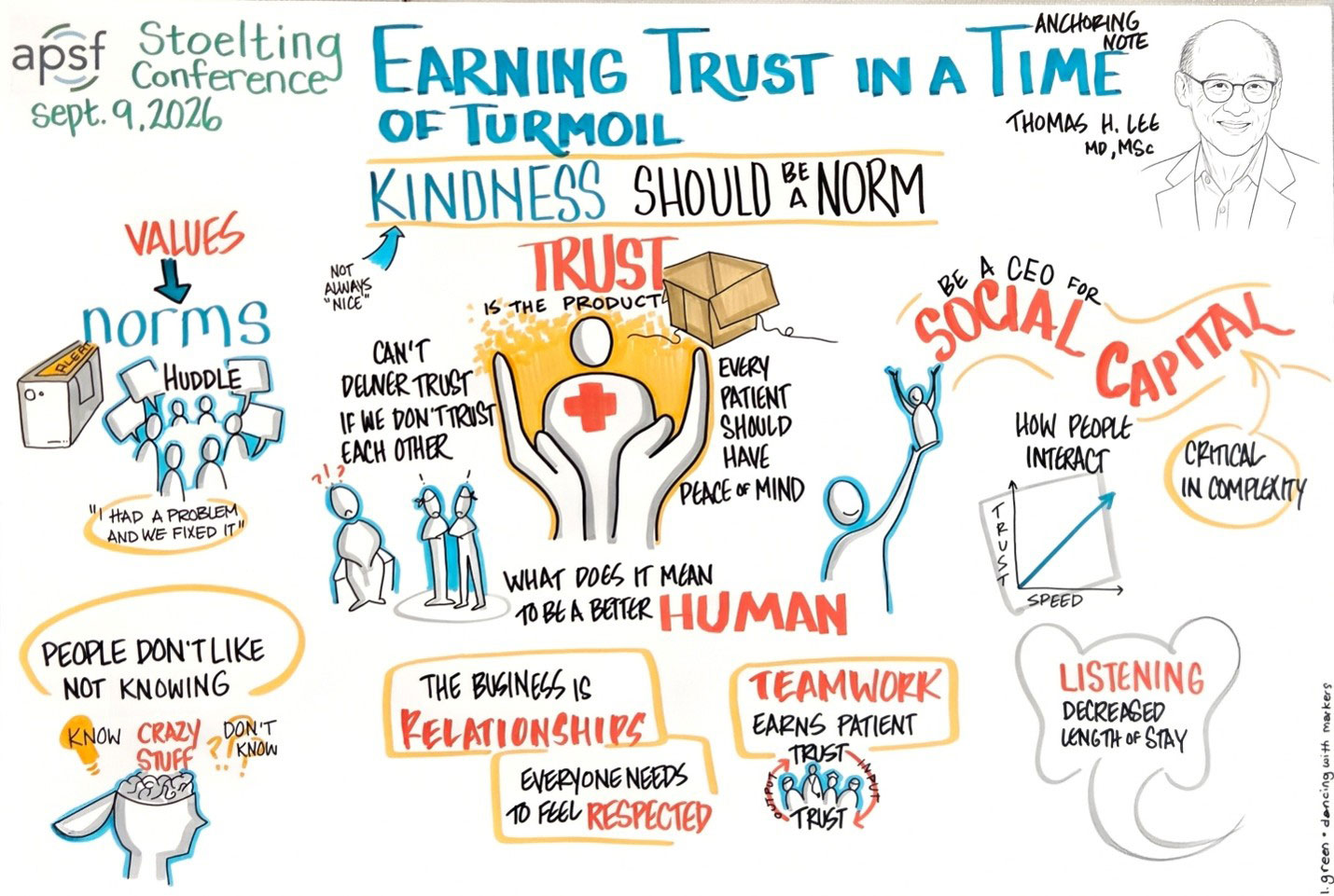
Here is the visual representation of Thomas’ talk:
Here are the citations that we talked about on the show today:
- https://hbr.org/2025/07/why-kindness-isnt-a-nice-to-have
- Montroni I, Ugolini G, Saur NM, Rostoft S, Spinelli A, Van Leeuwen BL, De Liguori Carino N, Ghignone F, Jaklitsch MT, Somasundar P, Garutti A, Zingaretti C, Foca F, Vertogen B, Nanni O, Wexner SD, Audisio RA; SIOG Surgical Task Force/ESSO GOSAFE Study Group. Quality of Life in Older Adults After Major Cancer Surgery: The GOSAFE International Study. J Natl Cancer Inst. 2022 Jul 11;114(7):969-978. doi: 10.1093/jnci/djac071. Erratum in: J Natl Cancer Inst. 2024 Jun 7;116(6):996. doi: 10.1093/jnci/djae092. PMID: 35394037; PMCID: PMC9275771.
When it comes to shared decision making, here are 4 “BRAN” questions that patients can ask to make better decisions together:
- What are the benefits?
- What are the risks?
- What are the alternatives?
- What happens if I do nothing?
We also talked about a practical framework for ethical and surgical decision making starting with these 5 questions:
- What abilities make life worth living?
- Would temporary rehabilitation in a facility be acceptable?
- What about requiring permanent help with ADLs?
- Which treatments or states are strictly unacceptable?
- And What is the exact nonoperative trajectory?
This episode was edited and produced by Mike Chan.
Subscribe to our YouTube Channel here: https://www.youtube.com/@AnesthesiaPatientSafety
Be sure to check out the APSF website at https://www.apsf.org/
Make sure that you subscribe to our newsletter at https://www.apsf.org/subscribe/
Follow us on Twitter @APSForg
Questions or Comments? Email me at podcast@apsf.org.
Thank you to our individual supports https://www.apsf.org/product/donation-individual/
Be a part of our first crowdfunding campaign https://www.apsf.org/product/crowdfunding-donation/
Thank you to our corporate supporters https://www.apsf.org/donate/corporate-and-community-donors/
Additional sound effects from: Zapsplat.
© 2026, The Anesthesia Patient Safety Foundation
Opening Clip: [Thomas Lee] “I’m focusing here on trust, and I think it flows naturally out of patient experience. My evolution to be interested in softer things than I was focusing on, really focusing on periop care earlier in my career is it is a natural one. When you think about what are we doing in healthcare? You know, we know we’re good people who are working really hard, but what are we producing with all this hard work? That question during a time of duress where you know there’s not enough money, not enough people, lots of pressure on us, is we’re stepping back to say, what are we doing? And I would make the case to you that trust is the product.”
[Bechtel] This is the Anesthesia Patient Safety Podcast and I’m your host, Alli Bechtel, an anesthesiologist. When I’m not working on the podcast, you can find me in the operating theatre providing anesthesia care or out on a trail run. For the past couple of weeks, we have been talking about seeing patients safely through the perioperative journey. This is our 2026 APSF Stoelting Conference series on “SOS!: Signals of Safety… Safely across the Patient’s Perioperative Journey.” We’re glad you’re here.
Before we dive further into the episode today, we’d like to recognize Fresenius Kabi, a major corporate supporter of APSF. Fresenius Kabi has generously provided unrestricted support to further our vision that “no one shall be harmed by anesthesia care”. Thank you, Fresenius Kabi, – we wouldn’t be able to do all that we do without you!”
Our first speaker today is Thomas Lee for his talk, “Earning Trust in a Time of Turmoil.” Thomas Lee is the Chief Medical Officer for Press Ganey and Editor-in-Chief of NEJM Catalyst. He is an internist and cardiologist and practices primary care at Brigham and Women’s Hospital in Boston. You heard his name on the podcast last week since he is the author of the book, “Social Capital in Healthcare,” which has a spot on the APSF Book Club list.
This was such a great talk and Thomas starts by asking some big questions like “What are we doing in healthcare?” and “What is our product?” And the answer may surprise you. Thomas tells us that this product may be trust. It is not immortality or complete restoration of health because we can’t always do this, but every patient should be able to trust that their doctor is doing everything that they can. This trust is a major focus for patients to trust their clinicians, for clinicians to trust their institution, and we can all see that trust is currently in turmoil in healthcare and perhaps around the world.
Another important question is “what about the impact of AI on trust?” This is something that we all need to consider moving forward. We don’t have a good answer right now, but healthcare professionals need to focus on being a good human and gaining trust from our patients.
History is happening right now in healthcare. We are seeing incredible clinical progress, growing complexity, rising expectations, financial pressures, burnout and shortages of people, and the rise of AI. There is a lot happening in healthcare for sure. Alongside all of these things, we also need to consider the following: teamwork, innovations, relationships vs transactions, kindness vs niceness, and rituals/manners instead of rules.
Thomas describes some of this complexity in medicine with this anecdote.
[Lee] “And I said, I can’t tell you exactly. Someone is going to call you sometime, but I can’t tell you who and when. But please answer your phone so we can get the echo. And my patient said, Why is it that everything in medicine is an adventure? You know, I can order something on Amazon and I know where it is, but you can’t tell me who’s going to call me and when. And all I could do is say, you’re you’re right.”
[Bechtel] Now, let’s get into the details about what earns patient’s trust? The answer from Press Ganey is clear and it is when patients see the medical staff working together. Teamwork is critical and patients are scared when we are not working together. If you have good teamwork and make it transparent, patients can see this and they respond positively. This is what they want to see. This builds trust. Trust is a core input and output. One consideration for trust is having confidence you are going to be treated fairly in circumstances that you have not thought of yet. This is relevant for patients, employees, consumers, and health plan members and the units of analysis have evolved over time. We don’t just want trustworthy individuals, we want and need to trust our team and the system.
Remember our APSF Book Club. One of the books is Thomas’ book, Social Capital in Healthcare. We have some spoilers now: Social capital is how people interact with each other and with their infrastructure using the currencies of respect, trust, teamwork, and high reliability. Social capital is needed most when there are complex problems, not complicated problems, but complex problems. So, it makes sense that we need social capital in healthcare. This is particularly important now given that there are important financial and human capital resource constraints. Given these constraints, we really need to take advantage of what we can control, like social capital.
When it comes to social capital, there are 3 key steps:
- Build connections.
- Strengthen connections.
- And transmit the right values and turn these into norms.
What does hard-wiring social capital look like?
Thomas provides an example from Mayo Clinic. Let’s take a listen now.
[Lee] “So you know that at Mayo Clinic, if you get a priority page, you answer immediately, correct? You don’t finish chewing what’s in your mouth. You start dialling, you don’t finish driving where you’re going. When I didn’t believe it when I heard it, because at the Brigham, you answer your page if you feel like it, when you feel like it, and no one pages. So um, but when I went to Mayo and I found it was real, my heart was broken. And I and I said, I was giving cardiology grand rounds, and I said, what happens if you don’t answer your page right away? And the first person said the earth would open up and swallow you. And the second one said, you’ll be put on the winter and the cold and you will die. Um and the third, a guy named Henry Ting, who you may know, uh, Henry said, look, you just don’t want people saying, you know, he’s the kind of person who doesn’t answer his page. So if you’ve got a norm, a real norm, you’ve got an enforcement mechanism. And that enforcement mechanism is social. So part of your role with CFO for social capital is making clear what the norms are and enforcing them, giving the feedback if someone doesn’t adhere to them.”
[Bechtel] Another good example of this is tiered huddles with the goal to bring problems into the huddle and then fix it. The norm is the huddle and the social part of this is bringing people together who can work to share information and solve problems.
The impact of social capital and building trust extends to outcomes like length of stay as well. This should give us all something to think about when we are caring for patients.
[Lee] “We worked with Vizient on a project where we merged their very detailed clinical data with and administrative data with our patient experience data. And what we found is that when uh patient experience is good, when patients report that their clinicians are listening well to them, what they found is that length of stay, adjusting for age, everything else, diagnosis, of course, uh, length of stay was better as well. Um, so that it was a patient experience impact on outcomes, including readmissions, but length of stay actually went down. When we went deeper into these data and we looked at the change in length of stay with doctor interactions, the same is true for nursing interactions. First, if the doctor explained things in ways you could understand, length of stay adjusted for everything in the VISINT database that we could went down more than half a day, which is uh the kind of thing that would make CFOs extremely excited. So the clarity of your explanations. But what was striking to me is that listening was actually even more powerful, a driver of good outcomes. The same thing is true for readmissions, bounce back to the hospitals in ED, and whether the doctor treated you with respect, even more powerful.”
[Bechtel] The big takeaway here is that relationships matter when it comes to patient care, patient safety, and even outcomes. So, how do we build these relationships and build trust? It starts with a foundation of respect and builds with teamwork and kindness. Is kindness a norm at your institution? If not, this may be a good goal going forward. Kindness requires action and involves supporting someone else’s interests and growth and is an important stepping stone for building social capital and psychological safety as well. After this episode, we hope that you will check out the Harvard Business Review article, “Why Kindness Isn’t A Nice to Have.” I’ll put the information in the show notes. It is clear that making teamwork transparent to our patients can help to build trust. So, the next time that you are talking with a patient before surgery, let them know that you talked with the surgeon and came up with a plan together for postoperative pain management or maybe you spoke with the patient’s cardiologist to come up with a medication plan. This could be an important building block for trust.
It’s time to move on to our next session, “No Surgery Without Shared Understanding.” The moderator is Colonel Steven Coffee who is a distinguished leader whose impact spans military service, healthcare advocacy, and academia. Colonel Coffee is the former military deputy assistant secretary of the Air Force for human resources policy affecting over 700,000 military and civilian personnel in the Air and Space Forces.
Let’s start with another big question: What is the relationship between consent and understanding?
Right away, I’m sure many people are thinking that consent does not equal understanding. A patient can sign the consent form even though they may not understand the why, that what if, or the what next about the procedure. Also, we can’t forget that documentation does not equal lived experience…what the medical chart contains is likely different from the patient’s lived experiences. And finally, recovery is part of the decision, so patients need to consider what happens when you go home and what is your standard of living after you go home following a procedure. We can bridge this understanding gap by explaining the why, not just the what using plain language, remember to frame timelines as estimates not deadlines and invite questions before anxiety sets in.
Our first speaker for this session is Professor Mike Grocott, who is back to talk about shared decision making. He starts by reviewing the burden of harm after surgery including complications and morbidity, death, and the cost. From the patient perspective, we can think of this as suffering, loss, and waste rather than complications, death, and cost.
[Grocott] “I’m going to step back in time a little bit for one of the aspects that underpins this notion of shared decision making. So this is a manuscript from the 1930s from a uh don’t be misled by the J. Allison Glover, it’s James Allison Glover. So this guy’s a dude, who is a family doctor who was commenting on or describing the then extraordinary prevalence of the operation of tonsillectomy. And he writes in this manuscript, so still fresh is the advent of anesthesia and the advent of asepsis. And all of a sudden we can do surgery and we can do it safely. And he writes about this extraordinary pandemic, if you like, of the operation of tonsillectomy. And that’s true in the United Kingdom and it’s true in the United States. And he pulled together a whole load of data in a paper that has become seminal in this field.”
[Bechtel] The key takeaways from this story are the high incidence of tonsillectomy surgery, variations between locations, socioeconomic status, and sex, and finally that there was no discernible harm from not operating. This is one of the first examples of supplier-induced demand, but it is not a unique occurrence. There is a difference between doing what we should do compared to what we can do…and then what we really need to do is examine what should we do for the patient based on what the patient wants?
Here’s a good framework for shared decision making. There are 4 “BRAN” questions to ask my doctor or nurse to make better decisions together.
- What are the benefits?
- What are the risks?
- What are the alternatives?
- What happens if I do nothing?
Shared decision making likely means clinicians and patients working together to select treatments based on clinical evidence and patient’s informed preferences. Here’s a memorable line to help you think about shared decision-making. “No decision about me without me.”
There are significant benefits from shared decision making including avoidance of wrong patient surgery where the harm outweighs the risk and fewer high-risk patients leading to less harm and reduced costs.
Next up, we are going to the other side of drapes to here from Dr. Ron Charles, who is an academic colorectal surgeon at Case Western Reserve University, educator, and healthcare leader dedicated to advancing both surgical excellence and the human experience within medicine and his talk, “Beyond Consent: Shared Decision Making for the Surgical Patient.
[Charles] “As a fourth year student, I was on my sub-internship doing internal medicine. And we had this really unfortunate patient that was there for six weeks. And she was in her 40s, if I remember correctly, had breast cancer that was metastatic, basically every organ system that you can imagine. And she would come back and forth into the hospital because she would get really significant pleural effusions and would have trouble breathing, came back, would get tapped, do okay, leave, and come back. And one time one of the attendings came up to us and said, Why is this patient, or have you discussed the fact that she is still full code? And the resident, the chief resident said, Yes. I just spoke to her about this. And he said, Well, what did you tell her? And the resident said, Well, I asked her, I said, if your heart were to stop, would you want us to give you medicines to get it to start again? Do you want us to shock you to see if we can get your heart going? And the patient said, Yeah, do it. And so the attending looked very squarely straight into the resident’s face and said, Is that informed consent? And he said, Do you know what happens when somebody codes and what we do? Um, and he then went into a few minutes of saying, you know, did you tell her we’re gonna take away all of her narcotics to reverse that so that we can get her breathing again and what that’s gonna do to her pain? And in the process of trying to resuscitate her, we’re gonna break her ribs, and she’s likely gonna get intubated and um probably unable to get off the intubate the uh the breathing machine. Uh, did you tell her that now her family is gonna have to make a decision about whether to get her off this machine and what happens after that? And it was that moment that it struck me that the conversations we have with patients really matters a ton. Because when we went back and actually had that discussion with the patient, she said, no, I, you know, I’m comfortable with changing my code status. And it was because of the quality of data, how we shared the information with her and her family, she was able to do that.”
[Bechtel] Once again, we need to highlight the difference between consent, a legal requirement, and shared decision making which is collaboration between the patient and the physician. Shared decision making is a conversation. It is evidence-based clinical intervention to help prevent unwanted care. The goal is value-concordant care and the flow of the conversation is bi-directional and collaborative. This is an iterative process that starts at screening and continues from here. The metric for success when it comes to shared decision making is patient comprehension of experiential trade-offs and this can be compared to a successful informed consent which is evidenced by a signature on a page.
Shared decision making is especially important if we think about older adults since incomplete recovery is common. 1 in 5 octogenarians and nonagenarians experience persistent functional decline at 30 days after inpatient surgery and 1 in 4 fail to achieve functional recovery at 3 months. This data comes from the GOSAFE international major elective cancer surgery cohort.
Going forward, we need to look at patient reported outcome measures. When we use patient reported outcomes measures in our clinical studies we often include population-level, older and comorbid patients and the patients self-report a wider spectrum of side effects, reflecting what it is like to live with these diseases or to live through these treatment protocols. There is an End-point evolution from can surgery treat the disease evolving to will I get back to my life. We are moving from the disease endpoint to the patient as the endpoint. It is not just binary survival but functional trajectories. The importance of 30 days mortality is being overshadowed by the importance of long-term quality of life.
Here is a practical framework for ethical and practical surgical decision making and it starts with these 5 questions.
- What abilities make life worth living?
- Would temporary rehabilitation in a facility be acceptable?
- What about requiring permanent help with ADLs?
- Which treatments or states are strictly unacceptable?
- And What is the exact nonoperative trajectory?
This was a really great talk and so nice to hear about shared decision making from the surgeon’s perspective.
[Charles] “The shared decision is whether probabilities, duration, and possible incompleteness of recovery is acceptable to the patient.”
[Bechtel] And that’s a wrap for our coverage of the Stoelting Conference today. We hope that you will join us for our final episode of this years coverage of the Stoelting Conference. We are also working on some exciting interview shows and APSF Newsletter article coverage so there is a lot of great anesthesia patient safety content to look forward to.
If you have any questions or comments from today’s show, please email us at podcast@apsf.org. Please keep in mind that the information in this show is provided for informational purposes only and does not constitute medical or legal advice. We hope that you will visit APSF.org for detailed information and check out the show notes for links to all the topics we discussed today.
If you can, we would love for you to subscribe to the podcast and maybe share it with a friend or a colleague or anyone you know who is interested in anesthesia patient safety. This way you can check out the entire Stoelting Conference Series and over 300 episodes in our archives. Thanks so much for listening.
Until next time, stay vigilant and stay informed so that no one shall be harmed by anesthesia care.
© 2026, The Anesthesia Patient Safety Foundation


