Episode #328 Discharge Is Not The Finish Line, Stoelting Conference Series, Part 2
October 14, 2026
Welcome to the next installment of the Anesthesia Patient Safety podcast hosted by Alli Bechtel. This podcast will be an exciting journey towards improved anesthesia patient safety.
This is the second episode in our series on the 2026 APSF Stoelting Conference.
Here are the visual notes for this episode!
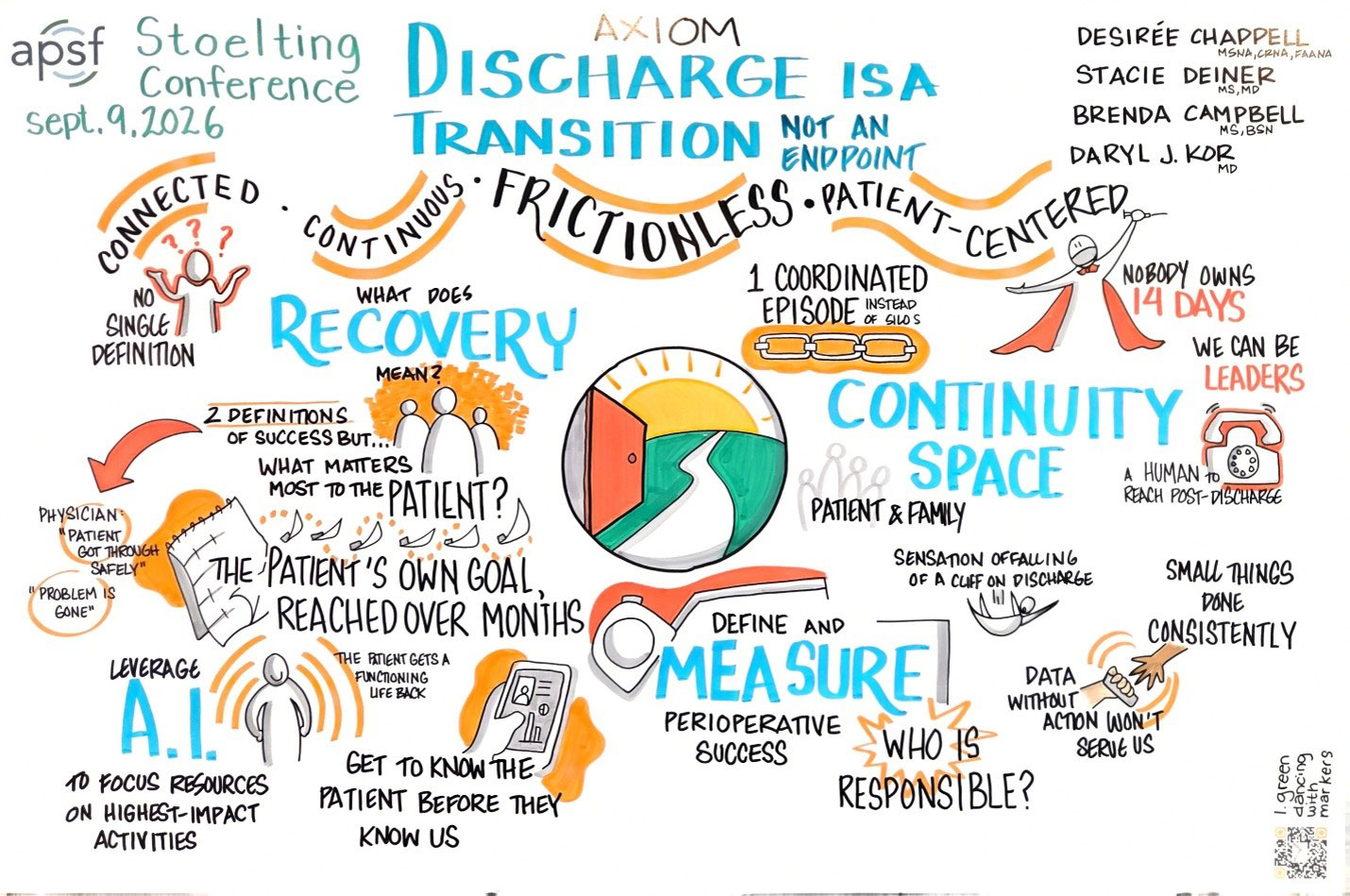
Axiom: Discharge is a Transition
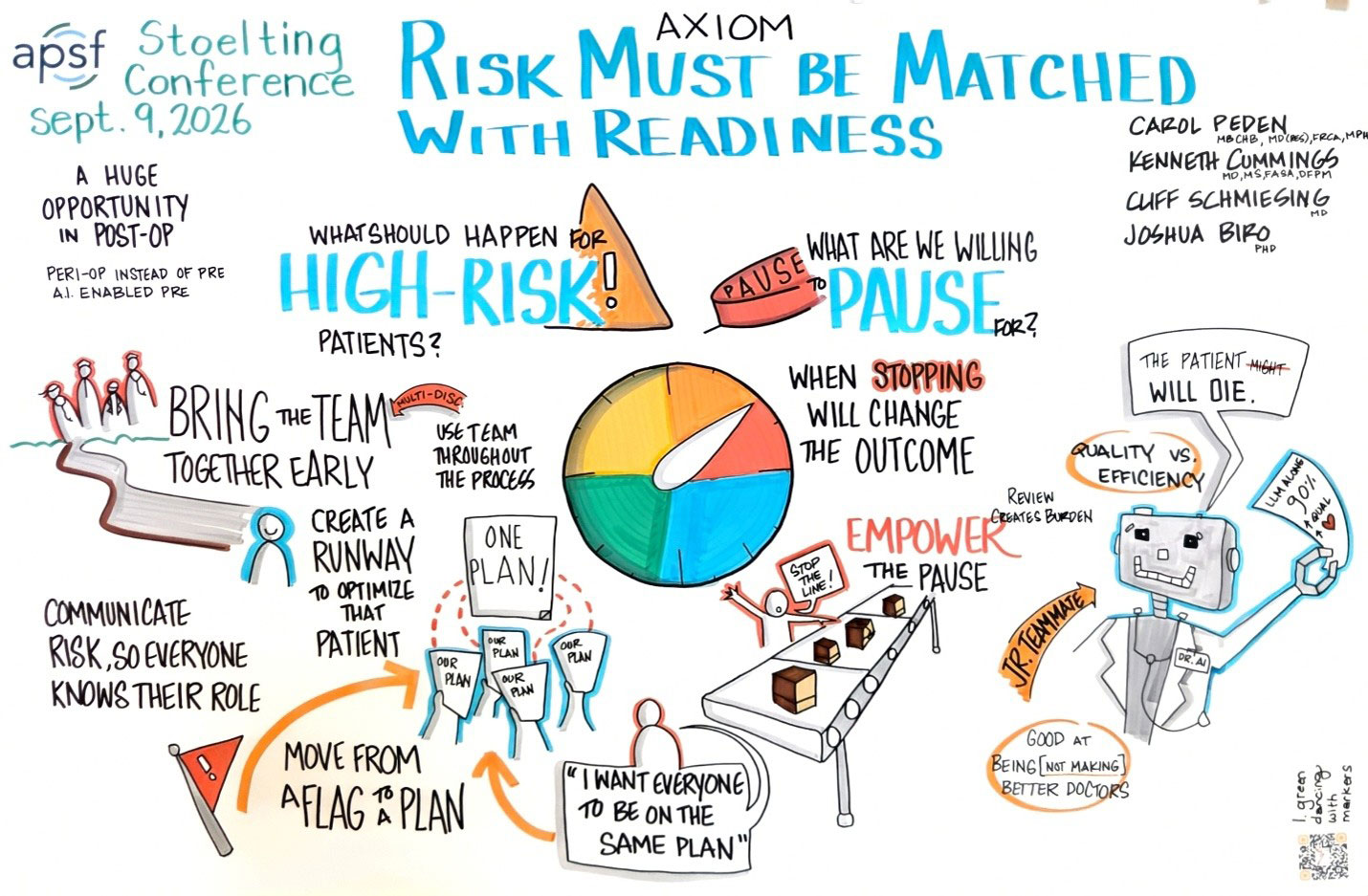
Axiom: Risk Must be Matched with Readiness
Visual Notetaking done by Lauren Green. Here’s her bio:
Lauren Green (she/her) is the owner and executive director of Dancing with Markers, a team of visual notetakers who specialize in the art of meeting and conference visualization. She believes in the power of visuals to enhance meeting memory. With an extensive background in meeting facilitation, Lauren specializes in visuals that support strategic planning. Her strategy maps show connections between current realities and future visions and serve as a building block for a well-developed strategic plan.
We hope that we can move the needle for patient success using the resources that we have and AI-generated tools when needed. Let’s consider the 4 Ms framework for age friendly healthcare including What Matters, Medication, Mind, and Mobility. You can learn more about the 4 Ms here:
Age-Friendly Health Systems | Institute for Healthcare Improvement
This episode was edited and produced by Mike Chan.
Subscribe to our YouTube Channel here: https://www.youtube.com/@AnesthesiaPatientSafety
Be sure to check out the APSF website at https://www.apsf.org/
Make sure that you subscribe to our newsletter at https://www.apsf.org/subscribe/
Follow us on Twitter @APSForg
Questions or Comments? Email me at podcast@apsf.org.
Thank you to our individual supports https://www.apsf.org/product/donation-individual/
Be a part of our first crowdfunding campaign https://www.apsf.org/product/crowdfunding-donation/
Thank you to our corporate supporters https://www.apsf.org/donate/corporate-and-community-donors/
Additional sound effects from: Zapsplat.
© 2026, The Anesthesia Patient Safety Foundation
Opening Clip: [Desiree Chappell] “In fact, we are using discharge as a metric of success. But today, this morning, we’re going to challenge that. Is discharge really the final destination? Or is it really about the recovery of the patient, what it looks like when they return home? Dan Sessler just said it’s not about when the patient comes to us and what they look like. It’s about getting them better, better than when they came to us, how they recover at home. And for us, for those of us in anesthesia, we’ve always kind of said the goal is just to get them out of the OR, like, ooh, I dropped them off in PACU and they’re still breathing and they look happy. I’m winning, right? Anybody in that perioperative care space knows that. But it’s not about that. Right? It’s so much more about what happens to that patient once they leave us from the OR and how they recover throughout the journey after that.”
Desiree Chappell helps to open this next session of the 2026 APSF Stoelting Conference. She is a CRNA and the director of medical affairs and medical science liaison with BD Advanced Patient monitoring.
This is the Anesthesia Patient Safety Podcast and I’m your host, Alli Bechtel. We are so excited to be bringing you our newest series covering the 2026 APSF Stoelting Conference. I was there in person and now we have a great series for you including lots of exclusive clips from the speakers. We also have research article and book recommendations, visual patient safety boards, and more. This year’s conference was “SOS!: Signals of Safety… Safely across the Patient’s Perioperative Journey.”
Before we dive further into the episode today, we’d like to recognize BD, a major corporate supporter of APSF. BD has generously provided unrestricted support to further our vision that “no one shall be harmed by anesthesia care”. Thank you, BD, – we wouldn’t be able to do all that we do without you!”
This next section will focus on Discharge as a transition and not an endpoint. For spoilers, check out show notes for a visual notetaking board.
The first speaker is Daryl Kor, DJ, a professor of anaesthesiology at Mayo Clinic and chair of the Department of Anaesthesiology and Perioperative Medicine at Mayo Clinic. Daryl is also the medical director of the perioperative information management, implementation, and analytics program. His talk is “Towards Frictionless Surgical Care.”
[Daryl Kor] “And I think for many of us we try to isolate our professional lives from our personal lives a bit. But on this date, my son, my oldest son, Peyton, he uh he had to go undergo kidney transplantation. And I was fortunate enough that I was able to serve as a donor in that process. Uh, but it completely changed the way I perceived what’s important to patients. What do they experience as they come through care at Mayo Clinic? And I would certainly say that I feel very proud to work at Mayo Clinic. I believe that we provide some of the best care in the world, but boy, did it open my eyes to some opportunities to provide better care than we were providing at the point in time we experienced that care.”
[Bechtel] DJ takes us from his personal story to his work at Mayo to help improve the patient experience with the goal to provide an unparalleled, frictionless experience for every person who requires anesthesia, critical care, or pain medicine services. Perhaps, we need to get to know our patients better before they know us. This could be accomplished with an automated way to capture patients’ relevant medical history before they present to the preoperative clinic or operating rooms. Then, once patients are admitted for surgery, using a command tower to provide efficient and frictionless experience rounded out with comprehensive postoperative follow-up.
DJ introduces the idea of care neighbourhoods to make care easier for patients. Can we put patients in the center of the healthcare environment and bring the necessary, multidisciplinary services to them?
After discharge home from the hospital, what happens when patients do need to come back for care? Usually patients would need to re-present to the emergency department and then re-create their medical history and story. This has been re-imagined at Mayo with rapid diagnostic and treatment centers with a goal to provide timely, high-value care for known patients so that they do not have to spend 6+ hours in the ED re-telling their story and getting to the diagnosis and finally appropriate treatment quicker and easier while keeping them safe.
We need to move away from the current system that is full of friction and labor intensive for patients and clinicians. The future transformed patient surgical journey will be connected and continuous, patient centric, technology, data, and AI driven, and working towards complete recovery.
Our next speaker is Brenda Campbell to talk about AI Powered Tools Improve Post Discharge Outcomes with a focus on the surgical patient population to help improve readmissions and mortality. Brenda is the Project Manager supporting Executive Leadership at Houston Methodist.
[Brenda Campbell] “Schedules an appointment, there’s been some referrals made, and it’s determined that a very simple procedure is going to take care of the hip pain. So let’s go ahead and schedule that procedure. Let’s go ahead and schedule it outpatient, and you’ll be in and out no problem. How often have we heard that, right? As part of this physician’s routine, we went ahead and sent that patient through pre-anesthesia testing. In the pre-anesthesia testing, we now discover that yes, the patient does have bilateral hip pain, but forgot to mention some significant congenital heart disease, especially as a young lady and growing up, and also has an AICD. So now we have a much more complicated patient. So we’ve changed our surgical plan just a little bit. We get some additional consultants involved, specifically her cardiologist. And then we want to go ahead and say, rather than let’s not take this patient into a simple outpatient procedure, let’s go ahead and schedule with an expert team of CV anesthetists, and now we’re going to move into the inpatient setting. Again, simple procedure, but very complicated underneath, so called. So nothing was wrong in that first clinic visit, right? Patients come in all the time. This patient wasn’t thinking about her heart. That wasn’t what was bothering her. It was really more about the hip pain.”
[Bechtel] Post discharge visits improve outcomes especially in the first 14 days for high-risk patients to decrease readmissions and mortality. We first talked about this last week on PART 1 of our Stoelting Conference Coverage. It was a repeated theme of the conference and an important consideration for keeping patients safe following anesthesia care.
Limited resources may make this feel difficult if not impossible to identify high risk patients and provide the recommended follow-up at 14 days postoperatively. AI is here to help and can identify high risk patients. Then, you can use this risk stratification to prioritize and direct our limited clinic resources. It really may be difficult if not impossible to accomplish this without appropriate risk stratification and without these AI-powered predictive tools. An important message is that everyone does not need the same standard of care. The data really supports this risk stratification to determine who is high risk and needs additional follow-up and who are our low-risk patients. The stakes are high here since readmission rates for postoperative surgical patients are much higher for the highest risk patients who are not seen in 14 days for follow-up, 36% compared to 20% for patients who have a follow-up appointment within 14 days. The big takeaway here is that the focus should be on seeing high risk patients within 14 days of discharge. What if instead of readmission rates, we look at mortality rates post discharge? Once again, there is a decrease for the group of patients who are the highest risk and are seen within 14 days of discharge. This is a simple way to improve outcomes, and it is an example of how small things, done consistently, can have a big impact and one simple intervention can lead to impressive outcome improvements. In this era of limited resources, it is important to prioritize resource utilization with risk stratification and use of AI to focus the resources on the areas where they can have the biggest impact. There is a call to action to go ahead and schedule your highest risk patients for 14-day follow-up care!
Next up, we have Stacie Deiner, the LeRoy Garth Professor and Vice Chair for Research at Dartmouth with her talk, “Did we succeed? Rethinking anesthesia and surgical outcomes through the patient’s eyes?”
[Stacie Deiner] “So I’m going to tell you the story of a typical patient of ours, maybe not even our worst, most dramatic patient. So Mrs. Johnson is 78 years old and she’s coming for hip replacement. At our hospital and maybe at yours, the two most common classes of procedures that we see are abdominal surgery and orthopedics, a lot of it being total joint replacements. Now, Mrs. Johnson has an uneventful anesthetic, her PACU course is smooth, pain was controlled, she’s not nauseated, she’s not even delirious, and she goes home the same day. Show of hands if you’re sending total joints home the same day. Yeah, a lot of us are doing that, and we call that a win, right? So she leaves the hospital, and now she goes through her next two weeks. Apropos of many of the speakers up here, she doesn’t have a 14-day follow-up. She can’t remember what medications to restart. She feels anxious about climbing the stairs. She’s still getting a little dizzy. She’s unstable on her feet. Maybe she doesn’t live with everybody, anybody. So she’s really trying to concentrate most of her living space to downstairs. She wants to go to physical therapy, but her ride falls through. Her daughter has to take unpaid leave and she becomes weaker and weaker. And then her toe catches on an area rug that no one thought to take up, and she falls and she comes back to the ED. That isn’t successful at all, right? We had hospital type success.”
[Bechtel] There may be 2 different definitions of success when it comes to keep patients safe… the hospital definitions of success and the patient definitions. Hospital success includes no intra-op awareness, stable vital signs, no PONV, average length of stay, no readmission, and no 48hr mortality. We are pretty good at hospital success measures. Patient success looks very different though: I can sleep, I can think clearly. I can climb the stairs. I can take care of myself. I can play with my grandchildren. I feel like me again.
We hope that we can move the needle for patient success using the resources that we have and AI-generated tools when needed. Let’s consider the 4 Ms framework for age friendly healthcare including What Matters, Medication, Mind, and Mobility. Check out the show notes for a link to more information about the 4 Ms framework.
Now, keeping these 4 Ms in mind, let’s re-imagine the NEW perioperative team….It’s gonna be a big team that includes the patient, surgeon, anesthesiologists, nursing, PT/OT, pharmacist, primary care, family, care navigator, and AI/Digital monitoring. And some people on this team may have overlapping roles to help keep patients safe. The PCP knows the patient is best and can be thought of as the quarterback. The anesthesiologist is responsible for the safety net or advocate for the patient and the surgeon is often the “captain of the ship or technician who determines the need for surgery. There is a call to action for anesthesia professionals to be leaders on this new perioperative team to use our expertise to help keep patients safe through the continuum of the perioperative care environment.
Stacie tells us about the Dartmouth Program for Older Surgical Patients which is a multidisciplinary team that meets every Wednesday for a tumor board type conference to provide recommendations to the surgical team. Some of the components include family rooms, healing arts visits, chaplaincy, pocket-talkers, behavioral intervention team, home safety checks, community nursing or paramedic visits and postoperative phone calls within 48 hours. Do you have something like this at your hospital? Perhaps you can be the next champion for older surgical patients.
[Stacie Deiner] “So Mrs. Johnson doesn’t remember her blood pressure. She certainly doesn’t care whether she got total intravenous anesthesia or a propofol. She doesn’t even know. She absolutely doesn’t know her Aldretti score in the PACU. But she does remember whether she got her life back, and she certainly has a strong opinion on whether it was a good idea, whether she did that surgery or not.”
[Bechtel] We leave this section about discharge as a transition, not an endpoint with some questions:
What does recovery mean? We are going to address this idea as well since it is a critical component of safe anesthesia care.
Our next session addresses the Axiom: Risk Must Be Matched with Readiness. The moderator is Carol Peden, an anesthesiologist and intensivist, and Adjunct Professor of Clinical Anesthesiology at the University of Pennsylvania and the Keck School of Medicine of the University of Southern California, and a Senior Associate Tutor at the University of Oxford in the UK. Here she is now.
[Carol Peden] “One brief example relevant to this axiom, risk must be matched with readiness. And one thing that came up at our table was okay, but what happens in the emergency situation? And my colleague Mike Rocott, who’s sitting at the front here, and myself and two other colleagues in the UK, over a decade ago, founded a national register for one of the highest risk surgeries, emergency laparotomy. And in the UK, that’s about 25,000 patients a year. And over that time, we’ve reduced the mortality from around 15% to 8%. And one of the things we introduced in the emergency situation was risk scoring the patient. And if you had a risk score entered into your record prior to surgery, and you were paired or matched with another patient with the same risk going in, but who wasn’t formally risk-scored, you did better. Your outcome was better by nature of having a risk score communicated through your record. Why was that? Well, we did some background research. Emergency teams value a data that they can communicate amongst themselves. So it facilitated communication between anesthesia surgery, ICU. So I’m a huge fan of this, but as it says up there, risk must be matched with readiness. So it’s this risk and action. What are we going to do?”
[Bechtel] Our first speaker is Cliff Schmiesing, clinical professor in the department of anesthesiology, pain, and perioperative medicine at Stanford. His talk is “Brining AI into the Anesthesia Preop Clinic.” Since the preoperative period is how we can get patients ready for surgery let’s learn a little more about the Stanford preoperative clinic. Up until 2016, everyone was seen in person. Then, the clinic rolled out telephone visits for certain patients. Then, in 2020, virtual visits started. Following the pandemic, the Stanford preoperative clinic has settled into about 50% in person and 50% virtual visits.
Now, let’s take a tour of the preoperative patient timeline and workflow. It starts with patient surgical consultation, then surgery is scheduled at a location and then referral to the preop clinic is made. Our patient is scheduled in the preop clinic and an advanced practice provider or APP, reviews the patient usually the day before their clinic visit. The patient then presents to the preoperative clinic for their appointment which may involve diagnostic testing, referrals, scheduling a follow-up visit, and risk stratification. From here, we are getting closer to surgery, and the patient is given preop instructions, including medications, which ones to take, which ones to hold. The anesthesia assignment is made the day before surgery and the anesthesiologist reviews the patient before surgery and whew, we made it to the day of surgery.
Standford has a home-grown AI chatbot called ChatEHR(chatter) that is available to all clinicians. You can input prompts and then you can receive outputs that may include red flags for what to watch out for before surgery. This is an example of using AI to facilitate the preoperative anesthesia clinic note.
There are other ways that AI can be helpful. We can use it for preop clinic escalation criteria and let the AI-tool determine if patients meet the criteria to see an anesthesiologist in the preop clinic or if they can have a nurse only visit. AI can also provide support for clinical questions, education, and best practices. We have already talked about this, but AI can also help with preoperative risk stratification which is helpful to identify patients that may need additional resources postoperatively. And finally, it can help with medication reconciliation and generate medication instructions for patients before surgery. Have you tried this, put a patient’s medication list into AI to generate preoperative medication instructions? This can be an opportunity to generate clear and consistent medication instructions that are specific for the patient for their literacy level and perhaps even provide timely reminders, while without AI patients may struggle to read our handwriting or interpret our medication instructions.
There are current challenges in the preoperative assessment. Operational gaps include not seeing all patients, not enough appointments, lack of robust triage workflows, training, MD staffing, limitations of video and phone, and billing, and clinical gaps including time spent reviewing patient data, specialty and primary care referral, care coordination, developing and following clinical guidelines, time spent charting, meaningful risk stratification, repetitive workflows, variability in care, and lack of accessible outcomes data.
Lets take a listen to Cliff as he closes his talk.
[Cliff Schmiesing] “And this is my one kind of AI caution slide before I wrap up. They talk about de-skilling and un-skilling so that if clinicians are using AI, you can actually lose your skills. And I work with, I probably work with hundreds of APPs and physicians over my 30 years, and we’re all dedicated, hardworking, smart, but none of us have a major or minor in AI, and I doubt many of us even have a single CEME dedicated to AI. So I think one of the tasks, and hopefully we can ponder this here today, is how do we upskill ourselves for the coming AI task tsunami and to prepare ourselves. And what’s more, I’m not so worried about displacing our workforce just based on Stanford. We see 50,000 patients in our pre-op clinic who will in 2026, but there’s 90,000 that we’re not seeing. 30,000 who will have an anesthetic with us, and another 50 who are just scheduled for procedures without us. So we can make the 50,000 we see better, but I think we can make the 90,000 we don’t immensely better. And if you uh zoom out and apply those numbers to the to the United States, we do 50 million surgeries and globally 400 million a year. There’s just tremendous opportunities.”
[Bechtel] We still have a couple more speakers who are going to talk about matching risk with readiness and way more from this years Stoelting Conference, so we hope that you will tune in again next week for part 3 in our series.
If you have any questions or comments from today’s show, please email us at podcast@apsf.org. Please keep in mind that the information in this show is provided for informational purposes only and does not constitute medical or legal advice. We hope that you will visit APSF.org for detailed information and check out the show notes for links to all the topics we discussed today.
If you can, we would love for you to subscribe to the podcast and maybe share it with a friend or a colleague or anyone you know who is interested in anesthesia patient safety. This way you can check out the entire Stoelting Conference Series and over 300 episodes in our archives. Thanks so much for listening.
Until next time, stay vigilant and stay informed so that no one shall be harmed by anesthesia care.
© 2026, The Anesthesia Patient Safety Foundation


