Episode #327 SOS! Signals For Perioperative Safety: Stoelting Conference Series, Part 1
October 7, 2026
Welcome to the next installment of the Anesthesia Patient Safety podcast hosted by Alli Bechtel. This podcast will be an exciting journey towards improved anesthesia patient safety.
This is the first episode in our series on the 2026 APSF Stoelting Conference. For more information about the conference, talks, and speakers, you can check it out here: https://www.apsf.org/event/stoelting-2026/
You can also watch the full conference live stream or individual presentations.
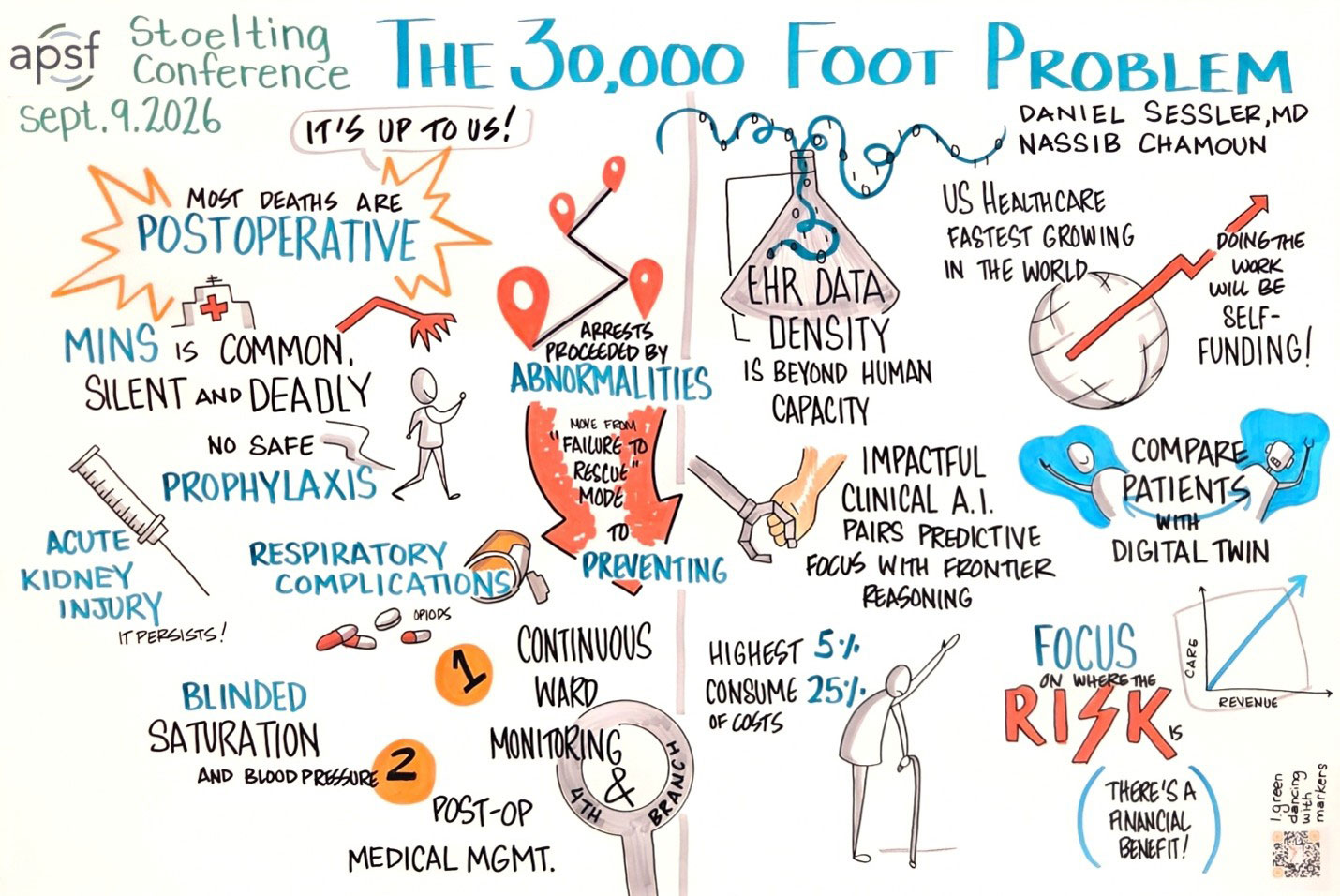
The highlights are captured in this beautiful visual note-taking summary!
Here are citation for the articles we talked about on the show today:
Zarbock A, Ostermann M, Forni L, Bode C, Wild L, Putensen C, Roux DP, Martín EE, Arndt C, Rahmel T, de Rosa S, Monard C, Schneider AG, Glass A, Jung-König M, Romagnoli S, Gossage J, Lumlertgul N, Haaker JG, Ripollés-Melchor J, Spadaro S, Siniscalchi A, Futier E, Aupetitgendre L, Bhathal IR, Álvarez RG, Bernard A, Rosenberger P, Wempe C, Sadjadi M, Meersch M, Fischhuber K, Bellomo R, Kellum JA, von Groote T; BigpAK-2 study group. A preventive care strategy to reduce moderate or severe acute kidney injury after major surgery (BigpAK-2); a multinational, randomised clinical trial. Lancet. 2025 Dec 13;406(10521):2782-2791. doi: 10.1016/S0140-6736(25)01717-9. Epub 2025 Nov 13. PMID: 41242333.
Khanna AK, O’Connell NS, Saha AK, et al. Continuous vs Intermittent Postoperative Vital Sign Monitoring: A Cluster Randomized Crossover Trial. JAMA Netw Open. 2026;9(3):e263290. doi:10.1001/jamanetworkopen.2026.3290
This episode was edited and produced by Mike Chan.
Subscribe to our YouTube Channel here: https://www.youtube.com/@AnesthesiaPatientSafety
Be sure to check out the APSF website at https://www.apsf.org/
Make sure that you subscribe to our newsletter at https://www.apsf.org/subscribe/
Follow us on Twitter @APSForg
Questions or Comments? Email me at [email protected].
Thank you to our individual supports https://www.apsf.org/product/donation-individual/
Be a part of our first crowdfunding campaign https://www.apsf.org/product/crowdfunding-donation/
Thank you to our corporate supporters https://www.apsf.org/donate/corporate-and-community-donors/
Additional sound effects from: Zapsplat.
© 2026, The Anesthesia Patient Safety Foundation
Opening Clip: [Della Lin] “Good morning. All right. Well, you recognize that signal. It was a signal, a global signal, um, that has helped save thousands of lives, right? And it actually turned 118 years old this July. Some say that it was sort of a global landmark of a situation where politically people were all divided, industry was divided as far as what a common signal would be for uh boats that are in distress. Um, prior to them coming up with a common signal, different companies had different ways of being able to express that distress. Marconi Communications Company used a signal that was CQD. Um the US Navy used visual signals, and so they wanted from the flags, and so their signal was NC. The Italians used SSS D D D. Light ships, which still were around at the turn of the century used H E L P help. And the Germans used SOE, which actually evolved into the SOS. They signed it as SOS, as something that they as a German as a country wanted to adopt in 1905. But it wasn’t until 1906 that globally, not just the countries in an intense political divide of, you know, everybody wanting to do their own thing, but industry as well, everybody kind of set aside their self-interest and decided instead of self-interest, let’s save lives. Now, 1906 was when they signed it. Uh, 1908 was when it was supposed to go into place. And uh the US actually didn’t sign in 1908. The U.S. didn’t sign until 1912. And some say that that’s because, in part because of what happened in the Titanic, which was probably one of the most well-known stories about the use of SOS.
I’ll tell you a little bit about that on that fateful night, April 14th, 1912, um, when the Titanic needed to issue a distress signal. They sent out a distress signal of CQD. They were actually outfitted by the Marconi Communications Company. So it was CQD six times. And then at some point, the second wireless operator, Harold Bride, said to the first operator who was um Jack Phillips, maybe we should try that new SOS signal. So they sent out the SOS signal. Um, and some say that one of the reasons that ships didn’t come to respond was because between the CQD and the SOS and the flares that they sent up and the bias that after all the Titanic was unsinkable, that people made the assumption that the Titanic was just having a party. In fact, about an hour or so before that, the SS Californian tried to send a note, um, an ice warning note to the Titanic. The Titanic was sending out Marconi grams. These were little telegrams that the luxury passengers could send to their family and their friends back at home to boast that they were on the ship. And so when the Californians sent that note of ice warning, the response back from the Titanic was a bit terse, a bit rude. It was shut up, we’re busy.
So my question is whether in healthcare we kind of have a similar situation. Do we have a situation where there’s confusion about what the signals are out there? Is there potentially bias that after all our hospitals are safe? Do we potentially carry that confusion and bias? I would say we don’t have an absence of signals, right? I mean, when you think about it, we’ve got innovative monitors out there, we have checklists, we have risk scores, we have all these kind of prediction things, we have AI. It’s not that we don’t have enough signals, it’s just that we haven’t decided what signals matter, what they mean, and what we’re supposed to do with them. So I think one of our challenges this morning or over the next couple days to think about the signals. Think about whether we can come to some shared understanding about what those signals are.”
[Bechtel] This is the Anesthesia Patient Safety Podcast and I’m your host, Alli Bechtel. We are so excited to be bringing you almost live coverage from the 2026 APSF Stoelting Conference. I was there in person and now we have a great series for you including lots of exclusive clips from the speakers. This year’s conference was “SOS!: Signals of Safety… Safely across the Patient’s Perioperative Journey.” Here are the objectives for the conference and we’re going to make sure to cover these during this podcast series, so lots of great information to look forward to over the coming weeks:
- Define six safety “axioms” for safe, frictionless perioperative care
- Examine how safety is actively produced—and eroded—across the perioperative continuum.
- Understand the sociotechnical conditions required to safely integrate emerging technologies in and beyond the operating room
- Identify interdependent strategies that improves the reliability of patient-centered outcomes.
- Build a shared language of Always Events to enable teams to strengthen perioperative safety.
Before we dive further into the episode today, we’d like to recognize Preferred Physicians Medical, PPM, a major corporate supporter of APSF. PPM has generously provided unrestricted support to further our vision that “no one shall be harmed by anesthesia care”. Thank you, PPM, – we wouldn’t be able to do all that we do without you!”
Before we get to the first conference speaker, we heard from Della Lin, the Program Coordinator Chair who you heard from at the top of the show and Dan Cole, the APSF President. Dan also reminded us of this quote from Ellison C. Pierce Jr the founding president of the APSF and it’s a good way to kick off this podcast and the Stoelting Conference Series. “Patient safety is not a fad. It is not an objective to be fulfilled. It is an ongoing necessity. It must be sustained by research, training, and daily application in the workplace.”
What a great call to action and with that, let’s turn to our first speaker, Terry Fairbanks, a professor of emergency medicine at Georgetown University and Senior Vice President, Chief Quality and Safety Officer at MedStart Health. His talk is, “We aren’t getting safer fast enough: Is the conflation of quality and safety holding us back?”
Let’s start with the broader, national perspective on patient safety and ask the question, are we getting safer?
We think so…but it is not fast enough. We need to pick up the pace. So, how do we do this? Terry provides 5 disruptive themes to help us get safer, faster. These include:
- Avoid Conflation of Quality and Safety
- Deliberately infuse true Safety Science
- Pre-empt harm with a Proactive focus
- Prioritize new safety Culture drivers
- Engage the entire healthcare industry in the Systems Approach
These all sound great, but we need to unpack them a little bit and this starts with examining the difference between quality and safety and health equity. Can you explain the differences? It might help if we look at it from the patient’s perspective. The patient might define quality as “how does my care measure up to best practice?” Patients may define safety as “Please don’t harm me.” And Health equity, which is just as important, as “Do I have a fair opportunity to be healthy, and to receive high-quality care?” It is important that we separate these concepts. There are different competencies for quality and safety and different training and knowledge required to be experts in each of these areas. We need to make sure that we don’t merge these terms if we want to get safer. Professionals can be experts in both quality and safety, but to be an expert in patient safety requires competency in safety science, culture, teamwork, patient communication, evaluating risks and mitigating risks, human factors engineering, psychological safety.
For the next disruptive theme…deliberately infuse safety science…it is important that we acknowledge the components of complexity and systems thinking, resilience engineering, and recognizing potential human error and usability and human factors engineering.
[Terry Fairbanks] “And I’m going to really drive that home. My favorite example, and for those of you who have heard this, I admit I have used this example for 20 years, but it is the one that resonates the best, I think. So patients goes into cardiac arrest on the monitor, right in front of the nurse, doctor, APP, whoever it might be, or paramedic, V fib arrest, they’re right there, they charge up the defibrillator, they go to hit shock, and instead of hitting the shock button, they hit the on button. What happens in this model and many, many models? There’s one manufacturer that has really fixed this in a hard way. What happens if you hit the on button in this defibrillator? The on button? It just turns off. Think about that. It just turns off. How long does it take to restart this machine? Two to three minutes, sometimes four, depending on the device, until you can actually defibrillate again. It goes through a whole computer startup. Four minutes equals, if we rely on the old data with V fib rest, 40% chance of saving this patient’s life. 40% more chance that they’re going to die. What is the consumer electronic device, any slide projector anywhere around, and I guarantee if I walk over to this one, this will happen. What does it do if I inadvertently hit the power button? It makes you confirm it. Why does it make you confirm it? Right. The electronics company, consumer electronics company, has assessed potential human error in its device, and it has provided an automatic protection from that automatic human error. What it didn’t do is make you sign an in-service that says to not push the power button when you don’t want to turn the device off. It did not try to train you when you bought the thing. It did not say that it’s in the instructions for use. It designed a safety piece in.”
[Bechtel] Why don’t we design equipment in healthcare that prevents errors? Instead, we just keep telling the humans, “don’t make that mistake.” Staying on this theme, we have a book recommendation for you. We hope that you will check out, “The Design of Everyday Things by Don Norman. Maybe this can be the first book for the APSF Book Club!
For the 3rd disruptive theme, we need to pre-empt harm with a proactive approach. This is the time to identify and mitigate existing risks, hazards, and dangerous conditions. Then, we need to prioritise the highest risks and then take actions to mitigate these risks.
Another important step, if we want to speed up patient safety improvements, is to prioritise safety culture. There is a gap between what leadership thinks about safety culture, they think that we are going great and what the front-line clinicians think, which is that there is still more work to do here. We need to close this gap and we can do this by promoting psychological safety.
Finally, we need to engage the entire healthcare industry in the Systems Approach, working together, the entire industry aligned to improve patient safety. For the healthcare industry, the product is a human being and there is a lot of variability…but we can learn from aviation to improve patient safety in this complex system. Aviation has taken a systems approach to safety, and this is something that we can and need to do in healthcare. The model in aviation involves a group that identifies the problem, the NTSB, and then CAST, the Commercial Aviation Safety Team, who works to solve the problem and this brings in the government, labor, industry, and observers all working together to help solve the problem. So, who would be on our healthcare CAST to help improve patient safety? This would include a diverse group including the people who deliver care, patients and families and the public, people who regulate, accredit, and pay, people who operate care systems, people who design products and technology, and people who understand and measure the risk. This is how we can engage the entire healthcare industry in a comprehensive Systems Approach.
Our next speaker is Daniel Sessler who is the Vice President of Clinical Research at UT Health and his talk is “The 30,000-foot problem. Perioperative Mortality.” Here he is now.
[Daniel Sessler] “In 1760, the French philosopher Voltaire wrote: physicians poured drugs of which they knew little for diseases of which they knew less into patients of which they knew nothing. For the next century, from our perspective, nothing whatsoever happened. Because anesthesia had yet to be invented. In fact, in 1860, exactly 100 years later, the medical school professor Oliver Wendell Holmes wrote: if all our drugs could be sunk to the bottom of the sea, it would be all the better for humans and all the worse for the fishes. But things were about to change because anesthesia had just been invented. And over the next century, anesthesia mortality decreased by a factor of a hundred. Since my residency, anesthesia mortality has decreased by another order of magnitude. This is remarkable. There’s no other specialty that has remotely reduced mortality by a factor of a thousand. It’s something that we can and should feel proud of.”
[Bechtel] When we think about perioperative mortality, we need to ask, what kills our patients? The answer is not the intraoperative period. Anesthesia professionals are very good at getting patients through surgery safely and intraoperative mortality is rare. This is a very good thing.
Postoperative mortality is common though, at about 2% after major inpatient surgery…this is the 3rd leading cause of death in the world. There are many causes including myocardial injury after non-cardiac surgery, or MINS. This has an incidence of 10% for surgical patients following major inpatient surgery and 93% are without symptoms. MINS is defined as troponin elevation with or without signs or symptoms. Typically, these are type 2 events due to a supply and demand mismatch. This can be identified by measuring troponins. There are significant risks to patients including readmission, MI, cardiac arrest, or death within 30 days, and 1 in 7 will re-infarct in the next 16 months. There is no safe prophylaxis for myocardial infarction and we have studied many different options including beta blockers, nitrous oxide, aspirin, clonidine, and tranexamic acid.
Another big problem is acute kidney injury. This is also 10% and is associated with significant complications and death. Single prophylaxis trials have not been shown to help, but going forward care bundles may help. Check out the study by Zarbock and colleagues published in the BJA in 2025 for more information about the KIDIGO Bundle which includes advanced hemodynamic monitoring, optimize volume status and hemodynamics, avoid nephrotoxic drugs and contrast agents, and prevent hyperglycaemia. The citation is in the show notes.
This is a concerning complication for patients. Did you know that 1/3rd of patients with Stage 1 AKI have persistent or worse kidney injury 1-2 years after surgery? This is a threat to patient safety that we need to address.
Respiratory complications are less common, but patients still die from postoperative respiratory complications and our goal is to get this number down to zero. These causes include obstruction, respiratory muscle weakness, reduced ventilation, often from pain, and impaired respiratory control including sleep apnea. Sessler highlights one of the major causes, opioids. Opioids alone increase the risk by a factor of 2 for the risk of respiratory arrest and when combined with sedatives this risk increases to a combined factor of 4. We don’t have this problem in the operating room since we are so good at monitoring in the OR, but this close monitoring does not continue on the wards postoperatively. When this is studied, we see that we are missing significant events on the ward with intermittent vital sign monitoring including oxygen saturations less than 90% and hypotension with MAP <65. For more information, check out the article by Turan and colleagues in Anesthesiology from 2019. Vital sign monitoring postoperatively is an area that needs work. We monitor vital signs the same way we did 50 years ago so we are still stuck on failure to rescue rather than preventing complications before they arise. It is sounding like we really need continuous vital sign monitoring on the ward for our postoperative surgical patients. There is a call to action that we need to protect the patient while it is happening and before we find them dead in bed.
Check out the 2026 study by Khanna and colleagues with almost 800 non-cardiac surgical patients randomized to blinded vs unblinded continuous vital sign morning. No statistically significant difference between the groups, but everything was improved with continuous monitoring by 30%. It was an under-powered, but these are really encouraging results and a sign that continuous ward monitoring may help.
Another way we can help is with postoperative medical management. Postoperative patients are generally sick, with significant comorbidities, and then they just had a big operation. Currently, postoperative management is not adequate. Right now, we fail to provide the necessary intense medical management for sick patients postoperatively. Perhaps, we need a 4th branch of anesthesia that focuses on postoperative medical management. This is another area where anesthesia professionals can save lives and keep patients safe. Here are the key takeaways: Postoperative mortality is the big problem. Intermittent postoperative monitoring is insufficient and sick patients need good medical management. Anesthesia professionals have the unique positioning to help manage these patients.
We have time to cover one more speaker today. Nassib Chamoun is the founder, president, and CEO of Health Data Analytics Institute, and here to talk about “Problem solving while connecting the dots: Quality, Safety, and Revenue.”
This is a timely matter. Everyone says that they want improved quality and safety, but they don’t want to pay for it…but there is some good news. This can be a self-funding endeavour with a large return on investment.
US Healthcare is one of the fastest growing economies in the world with a 9 trillion spend by 2034. This comes with challenges that include lower revenue, higher costs, and challenging outcomes due to reactive, diffuse care and a exponentially growing data burden. Clinicians are spending 1/3rd of their time hunting in the electronic health record. Does this sound familiar?
So, can we leverage technology and AI here to help?
Clinical AI can combine predictive stratification to focus the workflow with frontier reasoning, and this can help give clinicians more time to focus on their patients. Basically, being able to identify high risk patients and risk stratify all patients which then allows resources to be directed where they are needed.
Let’s look at some data. The health data analytics institute divides patients into 4 groups: advanced illness and hospice, complex, rising risk (these patients have no recent hospitalizations but have emerging chronic conditions), and low risk patients. 2/3rds of hospital utilization is from the top 2 groups and this is why it is important to stratify patients early. When patients receive an early 14-day follow-up, the mortality rate is decreased significantly especially in the highest risk patients. This is an example of focusing on where the risk is, the highest risk patients, and then applying the intervention, which is a 14-day follow up. The lowest risk patients may not need this 14-day follow-up, but we can see that the highest risk patients have decreased postoperative mortality and readmission rate when they have this 14-day follow-up. We need to align our resources with this critical risk stratification. The big take-home messages are: complex, high-acuity patients drive adverse events, mortality, and utilization. Perioperative mortality is most common postoperative and also after discharge. This is where the resources need to go to improve efficiency and patient safety.
Technology is critical. Here are future considerations to focus on:
- Preop screening and optimization to identify and target risk.
- Continued safe intraop management
- Postoperative monitoring and pre-discharge medical optimization
- And finally, post-discharge follow-up, especially for high risk patients with a 14 day follow-up call and appropriate management.
The impact is huge with improve patient outcomes and experiences especially if we can keep them from coming back into the hospital.
[Closing Clip from Nassib] [You can really make a big difference…20:50sec until the end maybe]
We started off on a high note and we are going to keep the momentum going next week when we return to our series on the 2026 APSF Stoelting Conference.
If you have any questions or comments from today’s show, please email us at [email protected]. Please keep in mind that the information in this show is provided for informational purposes only and does not constitute medical or legal advice. We hope that you will visit APSF.org for detailed information and check out the show notes for links to all the topics we discussed today.
If you can, we would love for you to subscribe to the podcast and maybe share it with a friend or a colleague or anyone you know who is interested in anesthesia patient safety. This way you can check out the entire Stoelting Conference Series and over 300 episodes in our archives. Thanks so much for listening.
Until next time, stay vigilant and stay informed so that no one shall be harmed by anesthesia care.
© 2026, The Anesthesia Patient Safety Foundation