Episode #288 Forty Years Of Perioperative Medication Safety Progress
January 7, 2026
Welcome to the next installment of the Anesthesia Patient Safety podcast hosted by Alli Bechtel. This podcast will be an exciting journey towards improved anesthesia patient safety.
Our featured article today is from the October 2025 APSF Newsletter. It is “APSF’s Forty-Year Commitment to Medication Safety in Anesthesia” by Aubrey Samost-Williams, MD, MS; Jeffrey Cooper, PhD; Arney Abcejo, MD; Elizabeth Rebello, MD, FASA, FACHE.
Thank you so much to Elizabeth Rebello for contributing to the show today.
Check out Figure 1 in the article for a visual representation of medication administration in the operating room compared to elsewhere in the hospital.
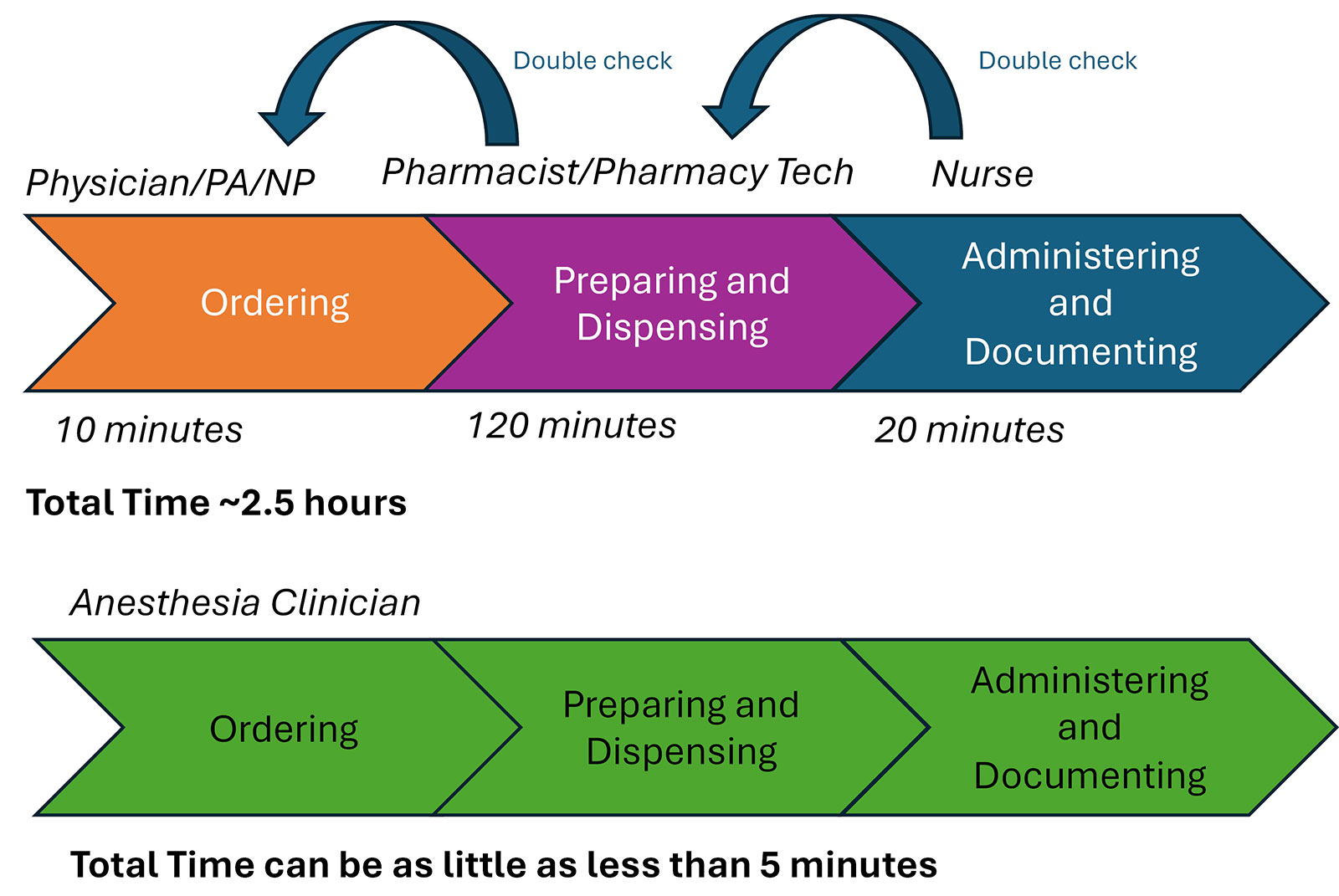
Figure 1: Comparison of the inpatient medication administration process and the OR medication administration process. Timing estimated from Bhansali and colleagues,7 Yen and colleagues,8 and internal pharmacy data.
Here are the links to other articles that we talked about on the podcast today.
This episode was edited and produced by Mike Chan.
Subscribe to our YouTube Channel here: https://www.youtube.com/@AnesthesiaPatientSafety
Be sure to check out the APSF website at https://www.apsf.org/
Make sure that you subscribe to our newsletter at https://www.apsf.org/subscribe/
Follow us on Twitter @APSForg
Questions or Comments? Email me at podcast@apsf.org.
Thank you to our individual supports https://www.apsf.org/product/donation-individual/
Be a part of our first crowdfunding campaign https://www.apsf.org/product/crowdfunding-donation/
Thank you to our corporate supporters https://www.apsf.org/donate/corporate-and-community-donors/
Additional sound effects from: Zapsplat.
© 2026, The Anesthesia Patient Safety Foundation
Hello and welcome back to the Anesthesia Patient Safety Podcast. My name is Alli Bechtel, and I am your host. Thank you for joining us for another show. Happy New Year! We are excited for another year of the Anesthesia Patient Safety Podcast in 2026 with Newsletter shows, interviews, conference reports, and more. To kick off the new year, we are returning to one of the most important considerations for keeping patients safe during anesthesia care, Medication Safety.
Before we dive further into the episode today, we’d like to recognize Solventum, a major corporate supporter of APSF. Solventum has generously provided unrestricted support to further our vision that “no one shall be harmed by anesthesia care”. Thank you, Solventum – we wouldn’t be able to do all that we do without you!”
Our featured article today is “APSF’s Forty-Year Commitment to Medication Safety in Anesthesia” by Aubrey Samost-Williams and colleagues. To follow along with us, head over to APSF.org and click on the Newsletter heading. First one down is the current issue. From there, scroll down to our featured article today. I will include a link in the show notes as well.
To help kick off the show today, we are going to hear from one of the authors. Here she is now.
[Rebello] “ Hi, my name is Elizabeth Rubo and I’m a professor of Anesthesiology and Perioperative medicine at the University of Texas MD Anderson Cancer Center. I also serve as the executive director for Anesthesiology Critical Care and Pain Medicine for the Cancer Network.”
[Bechtel] I asked Elizabeth why she wrote this article and why she is so passionate about this topic. Let’s take a listen to what she had to say.
[Rebello] “ I wrote this article to show that medication safety and anesthesia isn’t standing still. Okay. Over the last 40 years APSF has moved from Be More Careful to System Solutions. We highlight milestones noting conferences in 2010, 2018, and 2024. Real world actions such as lookalike vials, gallery advocacy on tranexamic acid packaging to prevent intrathecal errors, and the return of standardized color coding. That’s the ASTMD 4774 standard. This is a concise map of progress and the work still yet to come.
In the perioperative environment, one individual selects, prepares and administers drugs within minutes. Unlike the inpatient model that separates those roles, over hours, that compressed high stakes workflow makes us uniquely vulnerable to lookalike vials and variable concentrations. Patients deserve systems that make the right action, the easy action. Standardized labels and concentrations, prefilled syringes, barcode, young id, decision, support and adjust culture. This work directly prevents harm. We can measure and tragedies we’ll hopefully never have to see.”
[Bechtel] Thank you so much to Elizabeth for helping to introduce this important topic. And now it’s time to get into the article.
Medication Safety is one of the APSF’s Patient Safety Priorities and it has been a priority since the APSF was founded in 1985. Let’s take a look at the history of medication safety through the lens of the APSF.
The 1987 APSF Newsletter highlighted the problem of look-alike medications errors and since that time, over 140 articles on medication safety have been published by the APSF Newsletter. These articles highlight the importance of standardizing drug concentrations and equipment to reduce confusion and errors. Along with article publication, the APSF has worked hard to share research findings, best practices, and expert recommendations to help decrease medication errors and improve patient safety throughout the perioperative time period.
As we work towards improved medication safety, it is important to understand the unique challenges of medication administration in the operating room. Anesthesia professionals have a lot of responsibility here. We must select the medication and dose, prepare the medication, and administer the medication. In other hospital locations, these 3 functions are performed by 3 different groups of people. The physician, physician assistant or nurse practitioner selects the medication and dose. The pharmacist or pharmacy technician prepares the medication, and the bedside nurse administers the medication. When medication administration is shared by independent team members, there is monitoring and double-checking throughout the process. In the operating room, all of these steps are performed by the single anesthesia professionals and may need to be done quickly when seconds count in life-saving situations. Check out Figure 1 in the article for a comparison of inpatient medication administration process and the OR medication administration process. I will include this figure in the show notes as well. As you can see, inpatient medication administration may take over 2 hours with multiple clinicians involved and a couple steps to double check the order. In the operating room, the anesthesia clinician bears the sole responsibility and the entire process may be less than 5 minutes.
Medication safety during anesthesia care started with a focus on the behavior of the anesthesia professional including educational programs to support close reading of labels, design work to improve readability of the labels, and consistent labeling and color coding of medications. Over the years, safety science has evolved. We have learned that paying attention alone will not prevent medication errors. Instead, the paradigm has shifted to forcing functions and creating feedback mechanisms and constraints. And this brings us to the 2010 APSF Stoelting Conference on Medication Safety. We are going to review the past ASPF Conferences on medication safety to see what work has been done in the past so that we can chart out a course for where we are going in the future.
The focus for the 2010 conference was the creation of an expert consensus-based framework for moving medication safety beyond clinician attentiveness and on to the STPC framework that includes Standardization, Technology, Pharmacy/Prefilled/Premixed, and Culture. We are going to review the 2010 recommendations now. You can follow along in Table 1 in the article. As you listen, take note of which of these recommendations you are following in your institution and which ones are not part of your routine practice?
First up, here are the recommendations for standardization.
- High-alert medications should be provided in standardized concentrations.
- Infusions should be administered using electronically controlled smart devices.
- Machine-readable labels should be mandatory.
- Standardized placement of drugs within anaesthesia workstations and protocols for infusion libraries should be implemented.
- No concentrated versions of potentially lethal agents should be present in the OR.
Next, here are the technology recommendations:
- Every anesthetizing location should have a mechanism to identify medications before drawing up or administering them.
- Systems should provide feedback, decision support, and documentation.
- Mandatory safety checklists and improved user interfaces on infusion pumps should be required.
- Training and certification for users of technology should be established.
There are additional recommendations in the Pharmacy, Prefilled, and Premixed category:
- Routine provider-prepared medications should be discontinued.
- Clinical pharmacists should be integrated into the perioperative team.
- Standardized, pre-prepared medication kits tailored to case types should be used.
- Automated dispensing machines should be deployed in the operating room suite.
And finally, here are the recommendations related to culture.
- Establish a “just culture” for reporting medication errors (including near-misses) and learning from them.
- Implement mandatory education on medication safety.
- Promote cooperation across institutions, professional organizations, and accreditation agencies.
As you can see there is a lot of work to be done with the new framework. Let’s see what changed in the eight years in between Medication Safety Stoelting Conferences. In 2018, the APSF Stoelting Conference once again focused on medication safety. There were similar themes of the importance of standardization and human factors, but additional considerations included drug safety profiles and drug shortages. If you turn your attention to Table 2, we are going to review the 2018 recommendations now. This conference was almost 8 years ago. What recommendations are you following at your institution when it comes to medication safety? What areas need improvement?
First up, here are the recommendations for Drug Safety with the goals to identify and promote potentially safer anaesthetics:
- Encourage research on nitrous oxide
- Endorse the routine use of multimodal approaches for postoperative pain
- Endorse continuous monitoring of ventilation for perioperative patients
- Collaborate with the FDA and convene a work group to identify novel and potentially safer anaesthetics
We are definitely making progress on some of these recommendations with ERAS protocols that include multimodal analgesia options. There is also a new and potentially safer pain medication on the market that we talked about on this podcast last year. Suzetrigine is a new non-opioid medication used to help treat moderate to severe pain in adults. Check out episode #265 of this podcast for more information.
Next, here are the recommendations for drug shortages with the goals to share information, simplify ordering, and establish contingency plans:
- Provide up-to-date drug shortage information on the APSF website
- Encourage efforts to standardize concentrations of commonly used drugs
- Encourage the FDA to develop a manufacturer/supplier quality report card
- Collaborate to encourage contracting processes that lead to shared risks for drug shortages and quality issues
- Encourage the FDA to require manufacturers to have contingency plans to reduce the risks of drug shortages
The next section is Reducing Drug Administration Errors with goals to standardize procedures and doses, carefully document administration, and simplify preparation. Here are the recommendations:
- Encourage and endorse the use of prefilled syringes and standardized carts
- Encourage identifying and documenting drugs before administering them
- Encourage the development of technologies that can identify and document administered drugs
- Encourage efforts that promote perioperative work environments in which collaboration is encouraged and all individuals are encouraged to identify opportunities to improve patient safety
Finally, the last section is Standardization and Innovation with goals to collaborate across specialities and establish consensus for refined standards.
- Promote consensus on standardization of drug concentrations and labelling of drugs
- Collaborate to encourage health systems to standardize the delivery processes of high-risk drugs
- Develop a grant for the development of standardized labelling of vials and syringes
As you can see from these recommendations, there is a lot of work to be done to improve medication safety. After the 2018 Stoelting Conference, the APSF presented panels at the 2019 ASA and New York State Society of Anesthesiologists’ annual meetings. We hope you will check out the February 2020 article, “APSF-Sponsored 2019 ASA Panel on “Practical Approaches to Improving Medication Safety”
by JW. Beard and colleagues. I will include the link in the show notes as well. In this article you can find actionable strategies for anaesthesia professionals and other clinicians to improve medication safety throughout the perioperative period. The authors highlight that the goal for medication safety design requires the following considerations:
Eliminate unnecessary options (like excessive concentrations)
Automate processes like wireless programming smart pumps
And physically prevent mistakes like using the NR-Fit connectors for neuraxial anaesthesia
Another focus in 2018 that remains critical for medication safety today is medication shortages. The authors provide several suggestions to approach this threat to patient safety. Does your anesthesia group have a medication shortage committee to review developing and resolving shortages? Do you have a plan for waste reduction, use reduction, supplier change, substitute identification, or formulation change? How are you communicating these changes to the clinicians in the operating room? Anesthesia professionals also need to be alert to changes in medications that appear in our medication cart as a result of drug shortages or supply disruptions.
There was further education and efforts to increase awareness about challenges to medication safety with multiple APSF Newsletter articles dedicated to this topic in 2020. The APSF also sponsored a summit in 2021 with the Institute for Safe Medication Practices. Check out the June 2022 APSF Newsletter article, “Highlights from the ISMP Summit: The Future of Perioperative Medication Safety: Charting Our Path Forward” by Elizabeth Rebello and JW Beard. You can find the link in the show notes.
During the summit, important questions were asked about labelling, barcode scanning, and smart infusion pump integration and optimization. Here are some examples of the labelling questions:
- Should handwritten labels ever be used for routine medication labelling?
- Should printing labels be considered best practice?
- Are you handwriting your own label now? If so, why?
- How do we get practitioners to recognize the risk associated with nonstandard labelling practices and adopt safe labelling expectations?
There is still more to talk about when it comes to medication safety. We still need to find out what happened at the 2024 APSF Stoelting conference and what discuss other APSF activities dedicated to improving medication safety. Plus, we are going to hear from Elizabeth again. We hope that you will join us next week for the exciting conclusion.
If you have any questions or comments from today’s show, please email us at podcast@apsf.org. Please keep in mind that the information in this show is provided for informational purposes only and does not constitute medical or legal advice. We hope that you will visit APSF.org for detailed information and check out the show notes for links to all the topics we discussed today.
As we begin 2026, thank you for being part of the Anesthesia Patient Safety Podcast community. Your commitment to learning, reflection, and safer care for every patient is what drives these conversations. If you found today’s episode valuable, please subscribe, share it with a colleague, and help us reach others who care deeply about patient safety in anesthesia. Together, through open discussion and shared experience, we can continue to improve outcomes and elevate the standard of care. We look forward to learning with you throughout the year ahead.
Until next time, stay vigilant so that no one shall be harmed by anesthesia care.
© 2026, The Anesthesia Patient Safety Foundation