


 PDF
PDF| Table of Contents |
TO THE EDITOR
Smart infusion pumps have many features that promote medication safety,1,2 but none of these are applicable if usability problems outweigh functionality. In June 2024, the Baxter Novum syringe pump was introduced at our institution, and usability issues led to decreased utilization of pumps by the anesthesiology department in our rapid turnover procedural areas. With the previous generation, smart pumps were used in approximately 3/4 of cases, but after the introduction of the Baxter Novum syringe pump, use decreased (Figure 1). Over the subsequent 4 to 5 months, smart pump usage returned to the previous baseline, consistent with clinician adaptation.
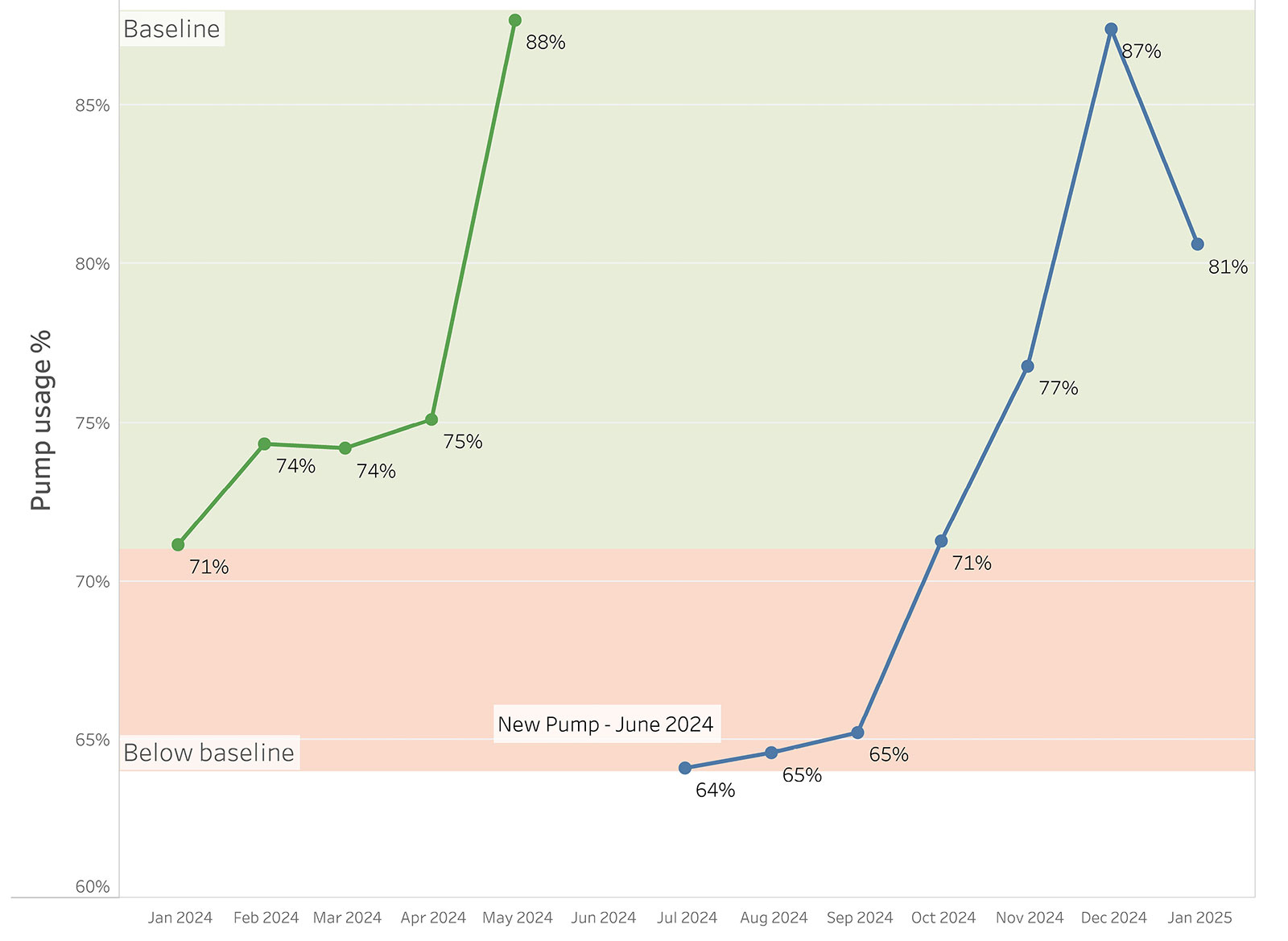
Figure 1: Smart infusion pump use decreased in rapid turnover procedural areas with introduction of Baxter Novum syringe pumps. Green shading denotes the band of baseline smart pump use while red shading demonstrates decreased pump use relative to baseline. Percent pump use is grouped by full month with the baseline plotted with green circles, and the Baxter Novum in blue.
A survey was conducted to better understand these changes. Respondents were also asked for a narrative assessment and Microsoft Copilot Artificial Intelligence (AI) was directed to summarize their responses with the prompt: “Please summarize the following comments with language appropriate for a health care administrator.” The AI summary follows: “The new syringe pumps are seen as cumbersome and time-consuming to program, with too many steps and redundant questions, particularly when changing syringe sizes, which requires restarting the entire process. This complexity and the inability to quickly swap syringes are viewed as unsafe, especially in fast-paced or critical care settings, leading some practitioners to avoid using them altogether. While the screen’s brightness is appreciated, the overall user interface is considered distracting and inefficient, impacting patient care and increasing medication waste and costs. The pumps are perceived as more suitable for inpatient use rather than procedural and operating settings.” Combining the survey data and measurement of smart pump usage, it is reasonable to conclude that there was decreased smart pump usage for several months after introduction of the Baxter Novum syringe pump due to usability.
Human factors, and specifically usability, have been extensively investigated and considered by organizations and in the medical literature. There are several articles in the APSF Newsletter on these topics,3–5 and medication safety is one of the core perioperative patient safety priorities of the APSF.6 The Institute for Safe Medication Practice sets a 95% compliance goal for smart infusion pump use.2 Research methods and frameworks for usability have been developed,7–9 and some health systems use human factors testing to inform procurement of new devices.10–12 The Food and Drug Administration (FDA) has published examples of reported infusion pump problems that include inadequate user interface design.13 The Association for the Advancement of Medical Instrumentation promotes human factors engineering and gives examples of usability with medical devices.14
Usability concerns with the Baxter Novum syringe pump were less pronounced for other clinicians in our health system; in fact, the reported Drug Error Reduction System (DERS) compliance is over 90%. The new smart infusion pump was introduced in all areas of two hospitals and several ambulatory/outpatient units. In most ways, the move to the Baxter Novum syringe pump has been advantageous with several benefits, including improved infrastructure such as the ability to update pumps wirelessly. This report focuses on smart infusion pump use by the anesthesiology department in rapid turnover procedural areas. It is logical to conclude that the priorities for a smart infusion pump are different for different tasks in the hospital and especially those specifically for administration of anesthesia.9,15 For example, changing syringes to different sizes can be a common task with smart pumps for anesthesia administration in a rapid turnover procedural area but would not be encountered in the workflow of antibiotic administration on an inpatient floor.
In response to these findings, the manufacturer sent a multidisciplinary team to visit the University of North Carolina in September 2024, which was much appreciated. Discussions are ongoing, and perhaps in the future there can be changes in the user interface and programming options for the Baxter Novum syringe pump that improve the performance for rapid turnover cases frequently encountered by anesthesiology professionals.
This is a complicated problem, and for our practice there are currently no straightforward solutions. For future changes, there is also a role for the anesthesiology community in addition to the APSF, regulatory agencies, and others to assist in improving smart infusion pumps. This letter is submitted to APSF to start a discussion with the premise that collaborative development of priorities for smart infusion pumps for anesthesiology is of benefit to all.
James H. Williams, MD, PhD, is a professor of anesthesiology at the University of North Carolina, Chapel Hill, NC, USA.
Kyra Walgos, PharmD, MS, CPPS, is a medication safety pharmacist in the Department of Pharmacy at the University of North Carolina, Chapel Hill, NC, USA.
Malgorzata Karpala, MBA, is a business operations analyst in the Department of Anesthesiology at the University of North Carolina, Chapel Hill, NC, USA.
The authors report no conflicts of interest.
REFERENCES
- Ohashi K, Dalleur O, Dykes PC, Bates DW. Benefits and risks of using smart pumps to reduce medication error rates: a systematic review. Drug Saf. 2014;37(12):1011-1020. PMID: 25294653
- Institute for Safe Medication Practices (ISMP). ISMP guidelines for optimizing safe implementation and use of smart infusion pumps. https://home.Ecri.Org/pages/ismp.
- Vanderveen T, O’Neill S, Beard JW. How can we tell how “smart” our infusion pumps are? APSF Newsletter. 2020;35(1):21-22. Available at: https://www.apsf.org/article/how-can-we-tell-how-smart-our-infusion-pumps-are/ Accessed January 22, 2025.
- Litman RS. Important medication errors and hazards reported to the ISMP national medication errors reporting program during 2020. APSF Newsletter. 2021;36(2):61-63. Available at: https://www.apsf.org/article/important-medication-errors-and-hazards-reported-to-the-ismp-national-medication-errors-reporting-program-during-2020/. Accessed January 22, 2025.
- Beard JW, Grigg E, Wahr JA, Rebello E. APSF-sponsored 2019 ASA panel on “Practical Approaches to Improving Medication Safety.” APSF Newsletter. 2020;35(1):24-25. Available at: https://www.apsf.org/article/apsf-sponsored-2019-asa-panel-on-practical-approaches-to-improving-medication-safety/. Accessed January 22, 2025.
- APSF Patient Safety Priorities Advisory Group. Perioperative patient safety priorities. Available at: https://www.apsf.org/patient-safety-priorities/. Accessed January 22, 2025.
- Blake JWC, Fiske SM, Giuliano KK. A qualitative analysis of intravenous smart pump usability. Nurs Open. 2022;9(4):2171-2178. PMID: 35591755
- Blandford A, Furniss D, Vincent C. Patient safety and interactive medical devices: realigning work as imagined and work as done. Clin Risk. 2014;20(5):107-110. PMID: 25866466
- Syroid N, Liu D, Albert R, et al. Graphical user interface simplifies infusion pump programming and enhances the ability to detect pump-related faults. Anesth Analg. 2012;115(5):1087-1097. PMID: 23011557
- Ginsburg G. Human factors engineering: a tool for medical device evaluation in hospital procurement decision-making. J Biomed Inform. 2005;38(3):213-219. PMID: 15896694
- Liu K, Chan FY, Or CK, et al. Heuristic evaluation and simulated use testing of infusion pumps to inform pump selection. Int J Med Inform. 2019;131(103932):103932. PMID: 31557700
- Herrero L, Sánchez-Santiago B, Cano M, et al. Prioritizing patient safety: Analysis of the procurement process of infusion pumps in Spain. Int J Environ Res Public Health. 2023;20(24). PMID: 38131730
- Examples of reported infusion pump problems. fda.gov. December 13, 2017. https://www.fda.gov/medical-devices/infusion-pumps/examples-reported-infusion-pump-problems Accessed January 22, 2025.
- Association for the Advancement of Medical Instrumentation. AAMI adopts human factors process standard. Biomed Instrum Technol. 2011;45(1):8-8. https://doi:10.2345/0899-8205-45.1.8a
- Schlotterbeck D. Infusion pumps and their safety in the OR. APSF Newsletter. 2000;15(4). Available at: https://www.apsf.org/article/infusion-pumps-and-their-safety-in-the-or/. Accessed January 22, 2025.
Response from Baxter Healthcare Corporation
Baxter’s mission is to Save and Sustain Lives and this concept is embedded into everything we do as a company, including product development and implementation – from idea inception, through product design and verification, and ultimately to our products’ use in patient care. This includes the Novum IQ Syringe infusion pump (Novum syringe), which received FDA clearance in 2023.
Infusion pumps are complex medical devices, and Baxter designed this pump to support complex infusion practices with a focus on patient safety and improved efficiency for clinicians. Thus, the design process for the Novum syringe included multiple clinician advisory meetings, a series of human factors studies involving multidisciplinary clinicians including anesthesiologists, and extensive internal testing by both Baxter’s Research and Development engineers as well as Baxter clinicians. That said, we expect the real-world implementation of our devices to offer opportunities to learn, adapt and improve, and we greatly value the collaborative feedback and discourse with Dr. Williams and his team at the UNC Health Anesthesia department.
Debbi Child, PharmD, BCPS, is the associate director for Global Medical Affairs for Infusion Systems.
LaShawn Carpenter, MSN, RN, is a principal medical liaison for US Medical Affairs for Infusion Systems.
Allison Hanson, PharmD, BCPS, FISMP, is the associate director for US and Canadian Medical Affairs for Infusion Systems.
All three authors are employees of Baxter Healthcare Corporation.