

 PDF
| Table of Contents |
DEAR RAPID RESPONSE:
A healthy 7-year-old boy with autism spectrum disorder presented for dental rehabilitation under general anesthesia. After standard monitors were placed, general anesthesia was induced using inhalation of volatile anesthetics. Once asleep, a peripheral intravenous line was placed, and the patient was prepared for nasal intubation with oxymetazoline nasal spray and placement of a lubricated nasal airway. A warmed 5.5 cuffed nasal RAE endotracheal tube (ETT) was then inserted carefully past the posterior nasopharynx. Using direct laryngoscopy, the ETT was visualized in the oropharynx and a pair of disposable infant-size Magill forceps was used to guide the tip of the tube into the glottic opening. The disposable Magill forceps, however, broke and came apart within the patient’s oropharynx (Figures 1, 2, and 3). It was discovered that the small screw holding the forceps together had failed and was sitting in the back of the patient’s oropharynx. At this time, the ETT was removed from the patient’s nare. The patient was given propofol (1 mg/kg intravenously) and very gently masked without excessive positive pressure out of concern for advancing the screw into the airway. A new set of disposable infant-size Magill forceps was opened to remove the screw from the patient’s oropharynx. Once the screw was removed, nasal intubation proceeded uneventfully utilizing the new set of Magill forceps, and the subsequent surgery was completed without incident. The patient had an uneventful postoperative course.
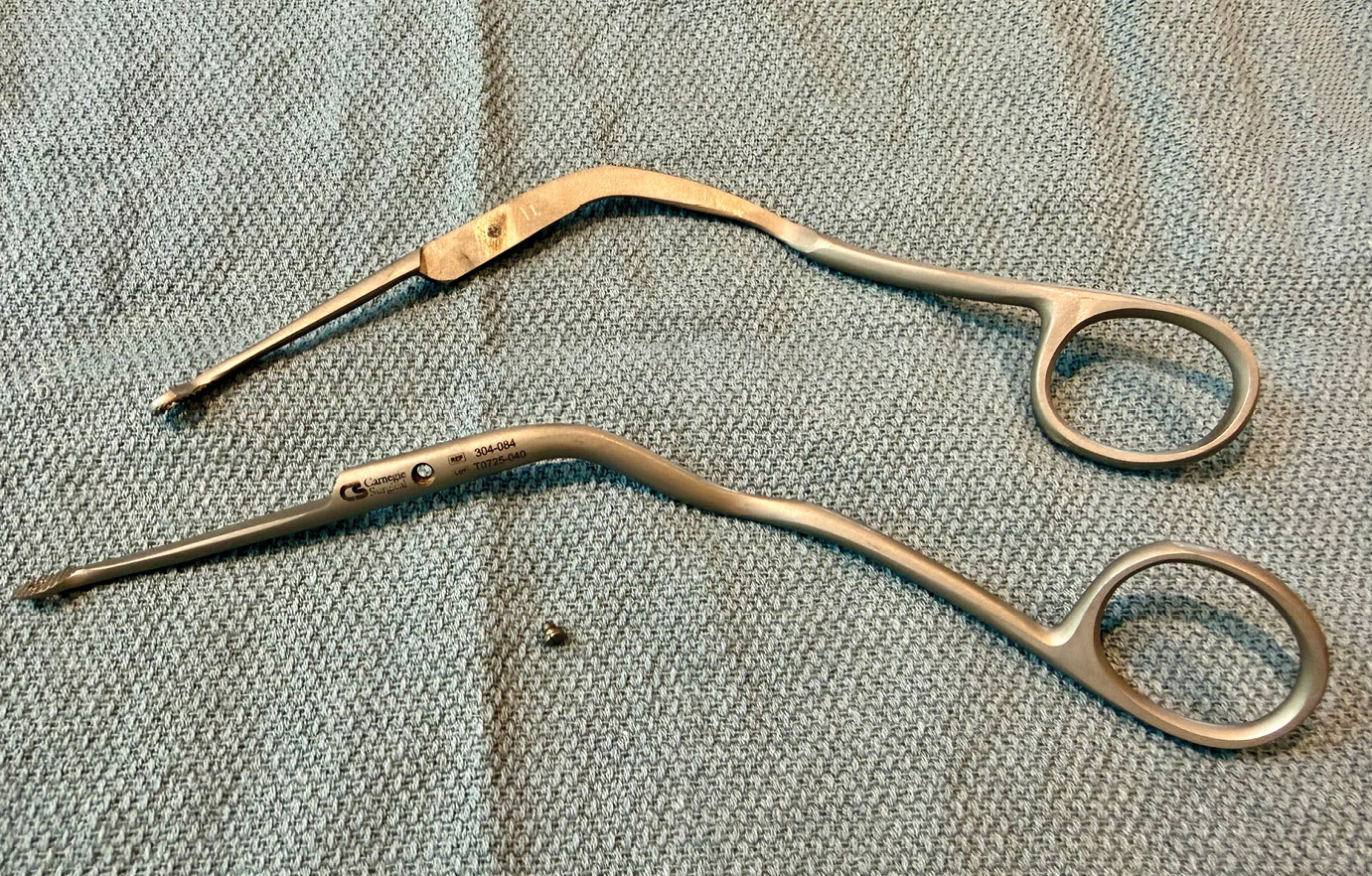
Figure 1
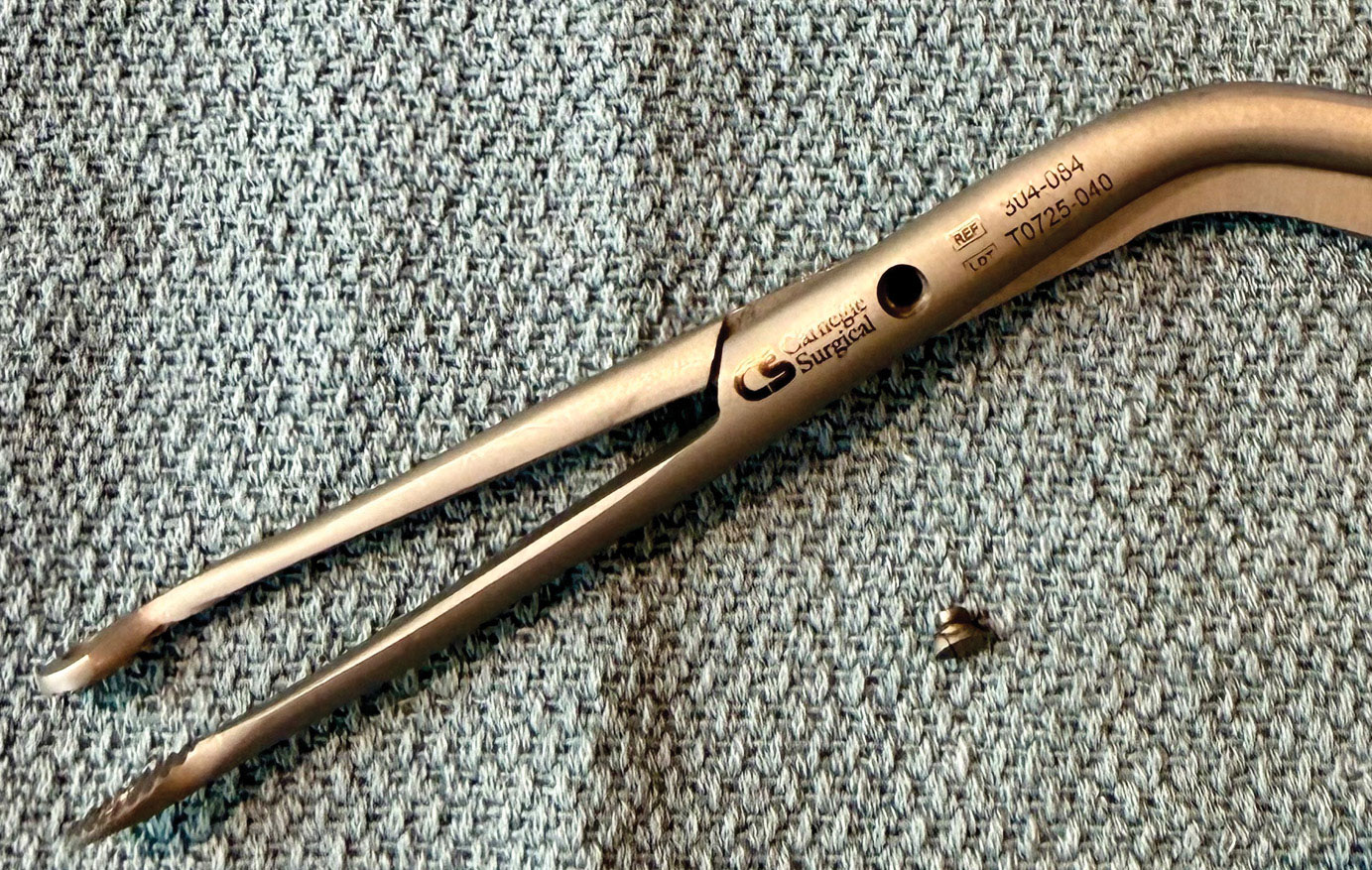
Figure 2
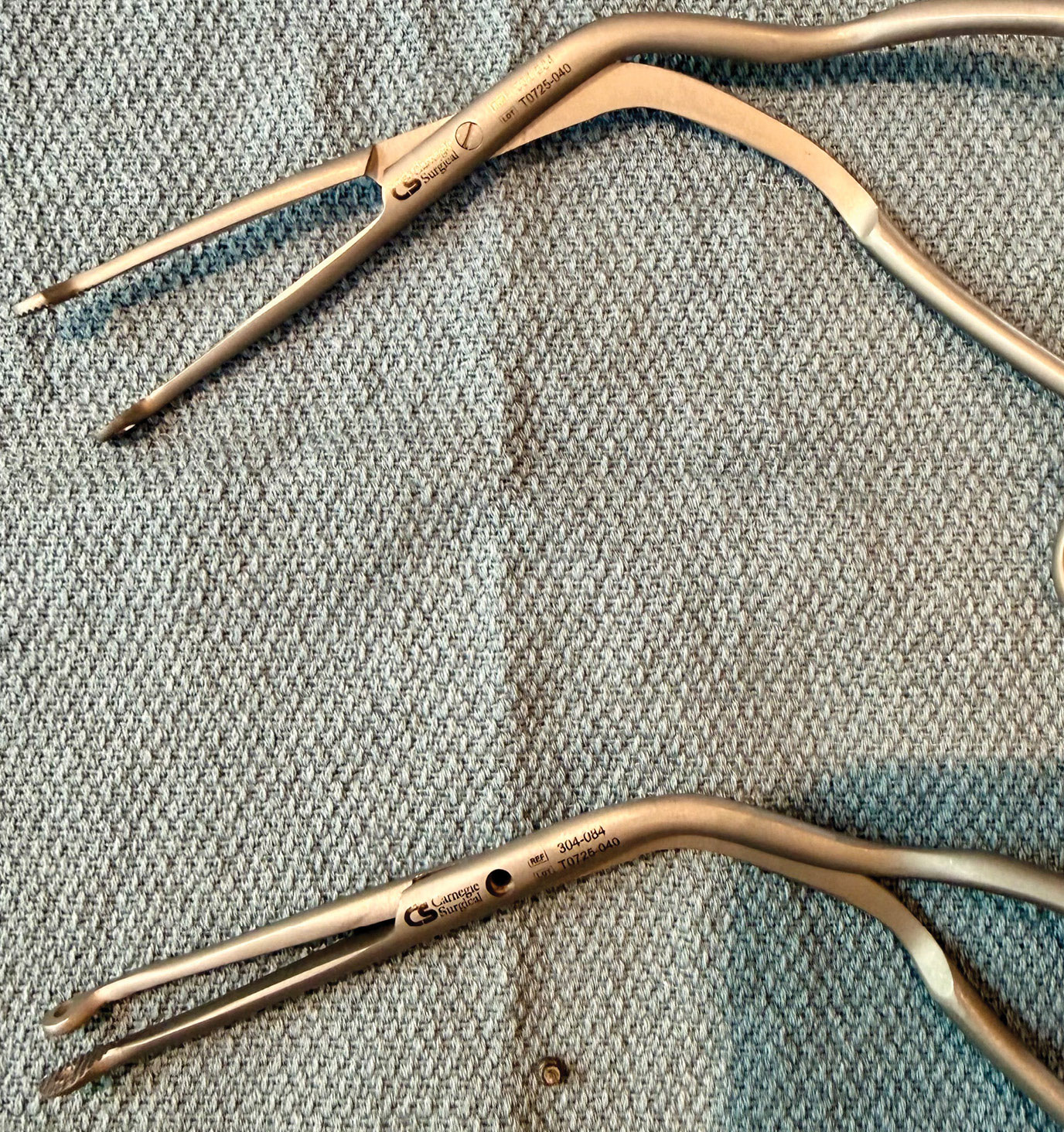
Figure 3
Figures 1–3. Close-up views of a fractured screw from infant-sized Magill forceps. One screw is used to hold the forceps together. In the failure, the screw had broken in half, with one half falling into patient’s oropharynx and the other half stuck in the Magill forceps.
DISCUSSION
This case highlights the potential risks associated with disposable equipment when it is not tested prior to patient use. In routine clinical practice, and in accordance with institutional guidelines, single-use airway equipment is typically kept sealed until the patient arrives in the operating room. Consequently, unlike anesthesia machines—which undergo standardized automated or manual checks—disposable airway devices are often not evaluated prior to utilization. Their functionality is generally assumed based on intact packaging. Additionally, Magill forceps are not always required for nasal intubation, as the endotracheal tube can sometimes pass from the nasopharynx into the glottis without needing to be guided by the forceps. As a result, these instruments may remain unopened unless specifically needed during the procedure.
In this case, the defective component, a broken screw, was not identified until opening the Magill forceps in the patient’s oropharynx. Fortunately, the screw fragment was immediately discovered and removed without complication, thereby avoiding aspiration or other adverse events. Notably, no excessive force was applied during the initial attempt to use the instrument, suggesting that the failure was due to a manufacturing defect. The hospital value analysis coordinator, who is responsible for ordering university supplies, was notified to contact the manufacturer Carnegie Surgical.
This incident underscores the limitations of presuming that disposable equipment is functional. It supports the recommendation that all single-use airway devices should be inspected and, where feasible, functionally checked immediately after opening and prior to patient use to enhance patient safety. Our practice has been revised to align with these recommendations. During dental procedures, the intubation process is paused once Magill forceps are identified as necessary, and the instrument is inspected immediately upon opening and prior to patient use.
Punit Singh, MD is an anesthesiologist at Arkansas Children’s Hospital, Little Rock, AR.
Punit Singh, MD, has no conflicts of interest.
CARNEGIE SURGICAL EVALUATION LEADS TO PROCESS IMPROVEMENT
by Mike Evans
In July 2026, Carnegie Surgical received a customer complaint involving a disposable Magill forceps (17 cm, infant size, Lot T0725-040). During airway management, the rivet pin securing the device’s jaws fractured, and half of the pin fell into the patient’s airway. Given the potential severity of such an event, the company launched a full root cause investigation.
Clinical use factors were ruled out based upon the provider attestation that the device was used as intended with no excessive force applied, and pre-use inspection protocols had been followed. Attention then turned to manufacturing.
A review of the Device History Record confirmed the raw materials and pin dimensions for this lot met specification. The investigation instead traced the failure to the assembly process. Forceps halves are joined by a rivet pin that is manually peened, or hammered flat, to lock the joint. Photographic evidence provided by the user showed the pin fractured along this peened zone, pointing to a micro-crack that most likely originated during machining and then propagated under the force of manual peening. Because rivet pins were checked only by sampling rather than 100% inspection, this particular defect went undetected until it failed under ordinary clinical load.
The root cause was determined to be a manufacturing and assembly defect; a potential contributing factor is machining-induced micro-cracking, compounded by stress introduced during manual peening.
Carnegie Surgical has implemented three corrective measures as a result of these findings: magnified visual inspection of all parts immediately after machining to identify micro-cracks before assembly, mandatory hands-on retraining for assembly fitters on proper peening technique to avoid over-striking, and a second magnified visual inspection of all devices at the fitting station following peening, before devices proceed to packaging.
This is the first component-breakage complaint since production of this forceps line began, and Carnegie Surgical considers it an isolated incident rather than a systemic trend. Enhanced inspection controls are now in place, and production performance will continue to be monitored under the company’s post-market surveillance program.
The author is employed by Carnegie Surgical. No other conflicts to disclose.
ALL DEVICES CAN FAIL—CHECK BEFORE USE
by Karen Haberland, Brad Bonnette, and Jeffrey Feldman, MD, MSE, FASA
In the report entitled “Disposable Airway Equipment Failure During Intubation,” Punit Singh, MD, reports a failure of a single-use Magill forceps during nasotracheal intubation that resulted in a metal screw fragment in the patient’s larynx, and inability to complete the intubation. The problem was managed with no resulting harm to the patient, but this incident raises some questions about selecting a single-use device for patient care. Furthermore, a review by the manufacturer resulted in a change in the quality control process to include a visual check of the component in question for every device manufactured. This discussion will focus on the quality of single-use devices and the importance of checking the device before use, leaving aside the other relevant questions around environmental impact.
Single-use devices are commonly used for the convenience of avoiding reprocessing and eliminating concern for transferring pathogens from one patient to another. The goal of manufacturers is to provide a device that is clinically useful at a price point consistent with disposal after use. Single-use devices, therefore, may be designed and manufactured differently since they are not intended to withstand the wear and tear of reprocessing and repeated uses. An important question is whether or not the single-use device is of sufficient quality that device failures, when used as indicated, are no more likely than with the reusable counterpart.
The report of Magill failure clearly indicates a fracture of the screw holding the forceps blades together. It is unclear if this a consequence of a less robust device or simply the inevitable occurrence of an occasional failure that is part of mass manufacturing. Reliable, systematically collected data on device failures is not available. The data that are available are based upon voluntary reporting to organizations like ECRI and the Food and Drug Administration (FDA) Manufacturer and User Facility Device Experience (MAUDE) database, which is specifically designed to record device failures. It is likely that device failures are underreported, but even with existing data, ECRI has included “substandard products” in their annual Top 10 Health Technology Hazards for the last four years.1-4
ECRI recommendations are based upon analysis of information from member hospital reports and monitoring of public databases such as MAUDE. The analysis indicates that there is a pervasive issue with substandard products in the health care supply chain. While adverse event reports are on the rise, there are no data specifically indicating that single-use devices have a higher rate of incidents than reusable devices. While the number of reports involving single-use devices is greater, there is a much larger, and increasing, volume of single-use devices being used. Regardless, all devices should be inspected prior to use for damaged or broken packaging seals, expired or mislabeled products, missing components, or visible manufacturing defects.
An excerpt from the 2026 Top 10 Hazards report provides some insight into the available data:
“ECRI has expressed concern multiple times in recent years about what appears to be a persistent, and potentially growing, problem: medical devices and supplies that are found to be of insufficient quality before, during, or after use. The number of alerts…[has] increased from 280 to 319 to 342 in the years from 2022 to 2024.”
ECRI concurs with the recommendation that clinicians examine both single-use and reusable devices prior to use whenever possible. In addition, defective devices should be reported via whatever mechanism a facility has in place and, whenever possible, sequestered with the packaging for further investigation. Even if a defect is found prior to patient care, ECRI recommends saving the device and reporting the problem to aid in trend analysis and better highlight ongoing quality problems. Facilities should have a robust, easy to use reporting process in place that allows for quick reporting without placing an undue burden on clinicians.
CHECK THE DEVICE BEFORE USE
For devices like the Magill forceps, the packaging is sterile so that opening the package to check the device means the device will be discarded whether it is used or not. The authors of this report have decided to open the package and perform a check once it is determined during airway management that the forceps are needed. This is a practical solution that avoids wasting the forceps if they are not needed. This process does result in a distraction for the anesthesiology team in the midst of airway management. One could argue that it is inexpensive insurance to open the package and check the device before induction. The benefit of being as prepared as possible to manage the airway without distraction may well outweigh the cost of wasting the device if it is not used. The best decision will be influenced by the expected complexity of the airway management and the number of people available to assist with airway management. A solo practitioner taking care of a difficult airway will likely want to prepare and check all necessary equipment prior to induction. An anesthesiology team of two providers caring for a straightforward patient can likely check equipment as it is needed without increasing the risk to the patient.
The decision to use a single or multi-use device in practice involves many factors, including quality, cost, workflow, and environmental impact. All devices need to be evaluated prior to use with all concerns reported to maintain patient safety.
Karen Haberland is a senior consultant with ECRI and reports no conflicts of interest.
Brad Bonnette is a senior consultant with ECRI and reports no conflicts of interest.
Jeffrey Feldman, MD, MSE, FASA, is professor of clinical anesthesiology (retired) at Perelman School of Medicine and Children’s Hospital of Philadelphia. He is also the chair of the APSF Committee on Technology. Dr. Feldman has compensated consulting relationships with Micropore Inc., Blink Device Company, and Draeger Medical.
REFERENCES
- ECRI. Growing number of defective single-use medical devices puts patients at risk. 2023 Top 10 Health Technology Hazards. Available at: https://home.ecri.org/blogs/ecri-news/gaps-in-recalls-of-home-use-medical-devices-top-ecris-hazards-list-for-2023?srsltid=
AU7gw4XZeizCP5Kj-s8RVB8Np8FIScfigaBlUOUssAXV-Jr66-XY6e2f. Accessed September 25, 2026. - ECRI. Poor QC of implantable orthopedic products can lead to surgical delays and patient harm. 2024 Top 10 Health Technology Hazards. Available at: https://members.ecri.org/guidance/poor-qc-of-implantable-orthopedic-products-can-lead-to-surgical-delays-and-. Accessed August 4, 2026
- ECRI. Substandard or fraudulent medical devices and supplies. 2025 Top 10 Health Technology Hazards. Available at: https://members.ecri.org/guidance/substandard-or-fraudulent-medical-devices-and-supplies. Accessed August 4, 2026
- ECRI. The growing challenge of combating substandard and falsified medical products. 2026 Top 10 Health Technology Hazards. Available at: https://members.ecri.org/guidance/the-growing-challenge-of-combating-substandard-and-falsified-medical. Accessed August 4, 2026
The information provided is for safety-related educational purposes only, and does not constitute medical or legal advice. Individual or group responses are only commentary, provided for purposes of education or discussion, and are neither statements of advice nor the opinions of APSF. It is not the intention of APSF to provide specific medical or legal advice or to endorse any specific views or recommendations in response to the inquiries posted. In no event shall APSF be responsible or liable, directly or indirectly, for any damage or loss caused or alleged to be caused by or in connection with the reliance on any such information.


