
 Articles
INTRODUCTION
This case report presents a case of difficult ventilation after induction of general anesthesia that was caused by a plastic obstruction in an anesthesia circuit filter, which was not detected during automated anesthesia machine checkout.
CASE REPORT
A 50-year-old woman with a BMI of 34 and a history of previous tobacco use underwent a left breast lumpectomy. General anesthesia with a supraglottic airway was planned for airway management, utilizing a Fabius GS Premium Anesthesia Workstation. The machine’s automated pre-anesthesia checkout was completed before the patient arrived in the operating room; a manual checkout of the circuit was not documented. After standard monitors were placed and adequate preoxygenation was achieved, general anesthesia was induced with lidocaine, propofol, and fentanyl. Immediately, difficulty with positive pressure ventilation was encountered. Peak airway pressures of 40 mmHg attained minimal tidal volumes and end-tidal carbon dioxide. Breath sounds were nearly inaudible upon auscultation. Suspecting laryngospasm as the culprit, 50 mg rocuronium was administered, and the patient was intubated. Ventilation continued to be difficult, and immediate assistance was requested. Treatments included albuterol delivery and 10 mcg doses of intravenous epinephrine for suspected severe bronchospasm. Inspection of the airway with a fiberoptic bronchoscope occurred within a few minutes of intubation. No blockage of the trachea or bronchi was identified. Upon reconnection of the circuit after bronchoscopy, ventilation completely normalized; this may have been secondary to inadvertent omission of the airway filter. Further inspection of the filter revealed a near-complete mechanical blockage of the ARC Medical CircuitGuard® filter caused by hard plastic, supposedly due to a manufacturing problem (Figure 1). No other interventions were necessary. During the crisis, the patient remained hemodynamically stable, and oxygen saturation was never measured below 80% SpO2. Subsequently, the surgery was completed without incident, and the patient had an uneventful postoperative course.
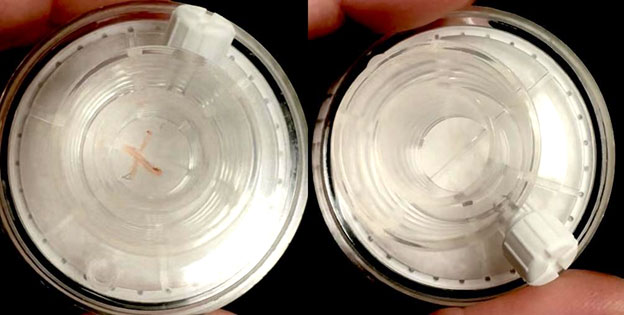
Figure 1: Comparison of the Occluded Filter (Left) vs. Correctly Manufactured Filter (Right). The red X was printed on the obstructing plastic membrane.
DISCUSSION
This case illustrates the potential for mechanical obstruction within the anesthesia circuit, which can cause life-threatening complications.1 The problems encountered highlight the limitations of automated anesthesia machine checkouts. The automated machine checkout of the Fabius GS Premium Anesthesia Workstation does not detect distal obstruction of the circuit and is only designed to detect ventilator problems and leaks in the system. A manual check for circuit obstruction must be implemented, as emphasized in this case. This checkout procedure is stressed in the 2025 ASA Committee on Equipment and Facilities Guidelines, which recommends confirming circuit patency manually, in addition to automated checkout.1 Interestingly, this patient never suffered measured oxygen saturations lower than 80% SpO2 in spite of preoxygenation using a near-complete obstruction of the anesthesia circuit. We hypothesize that the obstruction did not completely occlude the filter lumen, allowing for some oxygenation and positive pressure ventilation to occur. Quick thinking, early request for assistance, and a serendipitous removal of the obstructed filter early in the management prevented disaster. As a result of this case, several other defective filters were identified in the supply stockpile at our hospital. In addition, emphasis has been placed on performing the manual check for circuit obstruction prior to every anesthesia case.
Anna Richards is an undergraduate student at the University of Minnesota Twin Cities.
Dr. Jason Johnson is an anesthesiologist at Aspirus St. Luke’s Hospital in Duluth, Minnesota.
The authors have no conflict of interest.
REFERENCES
- ASA Committee on Equipment and Facilities. (2025). Recommendations for pre-anesthesia checkout procedures (2025 edition). American Society of Anesthesiologists.