

Outpatient Surgery: How Do I Choose the Safest Location?
Outpatient surgeries and procedures, where patients return home the same day, have become increasingly common over the last 20 years. They are now done in various settings, including hospitals, surgery centers, and doctors’ offices. Typical procedures done in outpatient settings include colonoscopy and minor plastic surgery. Even complex procedures like hip replacement are often now done on an outpatient basis. While usually safe, complications can still occur from the procedure, anesthesia, and underlying medical conditions.
Factors that contribute to safety include:
- The skill of the medical team.
- Location where the procedure is performed.
- The facility’s practices.
- Available emergency resources.
Non-hospital settings may be cheaper and more convenient but often have fewer resources to manage complications and emergencies.
Fortunately, by asking the right questions before an outpatient surgery, patients can make informed decisions. It is important for individuals to feel confident that their facility is safe and they will receive the highest possible standard of care. This guide explains the key factors that affect the safety of an outpatient surgery setting. It also provides a list of questions patients should consider asking their provider when planning an outpatient procedure.
What Patients Can Do: Ask These Key Questions:
- Where Will My Procedure Be Done?
- Who is Providing Anesthesia?
- Will I Have a Pre-Procedure Evaluation?
- How Are Emergencies Handled?
- Is the Facility Accredited and by Which Organization?
1. Where Will My Procedure Be Done?
Locations where these procedures are performed are quite varied. In most cases, the doctor will recommend the location for the procedure. While no doctor is interested in risking safety with any surgery, there is always the risk of complications. This is true for both major surgery and simple procedures.
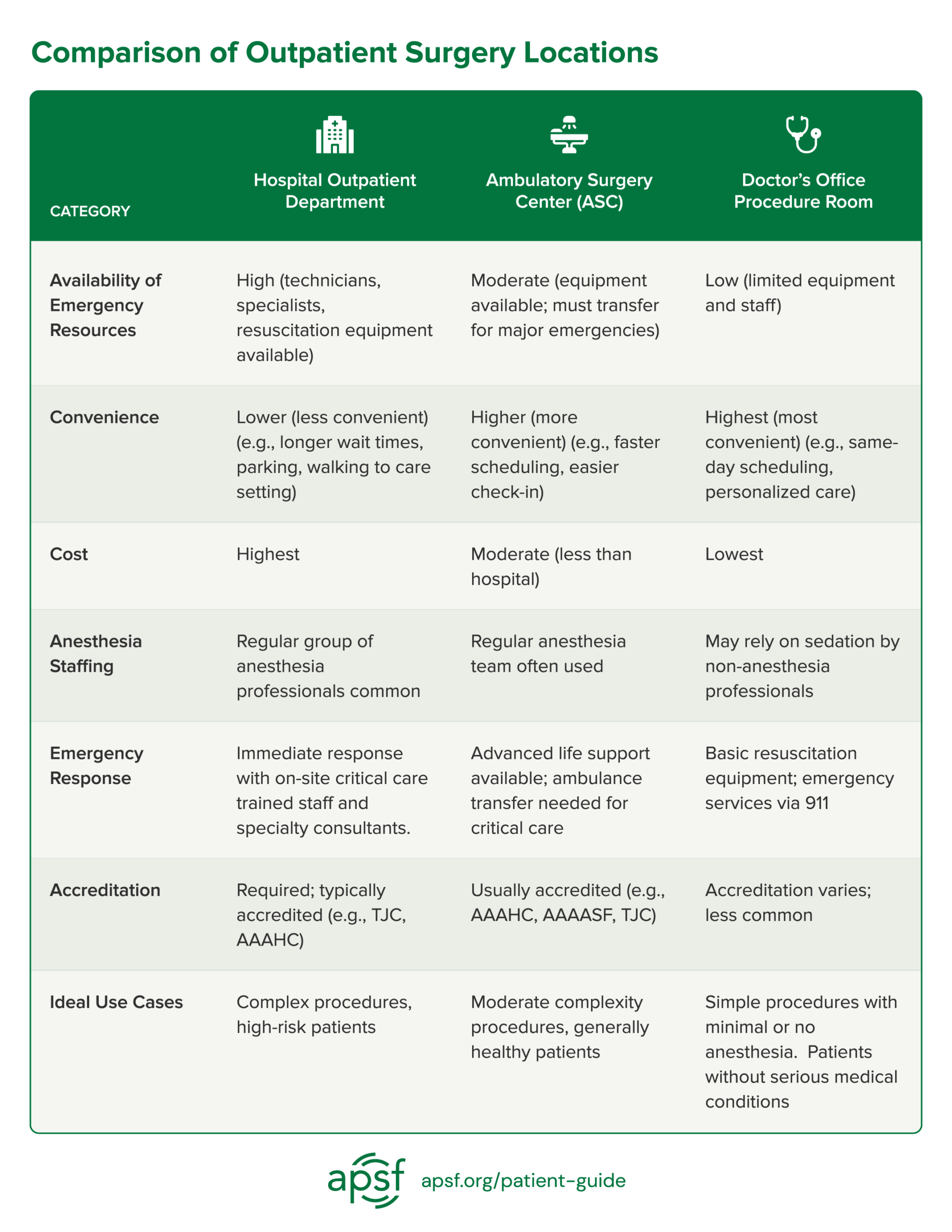
The biggest difference in safety between outpatient settings is the amount of support available if something goes wrong. These include equipment failure, a medication reaction, or a complication during the procedure. (See the table for a full comparison of locations.)
- Hospitals – usually have the most resources. There are trained technicians for troubleshooting and extra equipment supplies if needed. Backup emergency resources include medical specialists and resuscitation equipment. However, hospitals tend to be more expensive and less convenient for patients.
- Freestanding Ambulatory Surgery Centers (ASCs) – are often more convenient and cost less than hospitals. Larger centers typically have extra equipment and staff to handle problems. Smaller ASCs with only one or two procedure rooms may not be as well supplied. In serious emergencies, patients are usually transferred by ambulance to a hospital. Some ASCs are connected to hospital systems or have agreements in place with nearby hospitals for these situations.
- Doctor’s Office Procedure Rooms – are the most convenient and least costly. However, they usually have the fewest resources. Staff numbers are smaller, and there may be limited access to backup equipment or emergency support.
Click image for pdf
2. Who Is Providing Anesthesia?
Anesthesia care may be provided by several types of anesthesia professionals. These include physician anesthesiologists, nurse anesthetists, and anesthesia assistants.
At outpatient facilities, staffing may involve a regular group of anesthesia professionals that works consistently at the facility. They may also have temporary staff brought in on an as-needed basis.
Regular anesthesia staff are more likely to be familiar with:
- The specific procedures performed at the facility.
- The medical and surgical staff.
- The equipment and emergency protocols.
A regular anesthesia staff also often help set standards for the equipment used and guide the facility in maintaining safe anesthesia practices.
Patients should ask if the location planned for their procedure has permanent anesthesia staff or if temporary staffing is used.
In some cases, sedation may be given by a non-anesthesia professional such as a registered nurse supervised by the doctor doing the procedure. Registered nurses can be trained to monitor patients during sedation, but they do not have the same skills as anesthesia professionals when it comes to keeping patients comfortable or handling emergencies. For anything more than the simplest procedures, this type of team may have a hard time making sure the patient is both safe and comfortable.
3. Will I Have a Pre-Procedure Evaluation?
A pre-procedure evaluation, while not always required ahead of time for healthy patients, is often a sign that a facility focuses on safe care. This medical check is helpful for anesthesia professionals because it lets them assess risks and make a plan. For example, patients with high blood pressure, diabetes, or those taking blood thinners may need special steps to manage their medications before the procedure.
In some cases, a patient’s medical history may show that the procedure should be done in a hospital, where more support is available. The pre-procedure evaluation helps make that decision.
4. How Are Emergencies Handled?
The ability to handle a medical emergency can vary depending on where care is provided. In a hospital, the tools and trained staff needed for emergencies are usually available right away. This includes special equipment to manage medical problems and staff who know how to use it. These staff may include doctors and nurses with training in emergency and critical care.
In a freestanding ambulatory surgery center (ASC), especially one with multiple procedure rooms, key emergency equipment is also available. These centers also have extra staff to help in an emergency. The staff are usually certified in advanced life support, but emergency and critical care specialists are not on site. If more care is needed, patients must be transported by ambulance to a hospital. It is helpful to ask if the ASC has a set hospital it works with, or if the ambulance team chooses the hospital at the time of transport.
For procedures done in a doctor’s office, resuscitation equipment is usually present. However, fewer staff are available to respond during an emergency. In these cases, help and transport are generally provided by calling 911.
5. Is the Facility Accredited and by Which Organization?
Accreditation is an official review process that shows a facility meets important rules and safety standards. Asking if a facility is accredited might be the only question a patient needs to ask. Trusted accrediting groups usually check many things that affect safety. These include staff qualifications, clean procedure rules, emergency equipment, and plans to transfer patients if needed.
There are several organizations that give accreditation. Being approved by one or more of them usually means the facility meets accepted standards of care. Some of the groups that accredit outpatient surgery centers include:
- Accreditation Association for Ambulatory Health Care (AAAHC).
- The Joint Commission (TJC).
- American Association for Accreditation of Ambulatory Surgery Facilities (AAAASF).
- Accreditation Commission for Health Care (ACHC).
- State Boards of Health.
There are differences, however, in the criteria each organization uses to provide accreditation. It’s best to choose a facility accredited by a trusted group and avoid ones without accreditation.
Summary
All procedures carry some risk of complications. In general, the greatest risk occurs during more complex procedures that require anesthesia for safety and comfort. Patients with complex health problems should consider a hospital setting for outpatient procedures. Freestanding ASCs generally provide safe, cost-effective, convenient care. The best facilities are accredited, have regular staff, and offer pre-procedure evaluations. Office-based procedures should be reserved for short, simple cases ideally needing little or no anesthesia.
Share it:
-
Copy Link
 Link Copied!


