
Circuit Obstruction Mimics Bronchospasm back to top
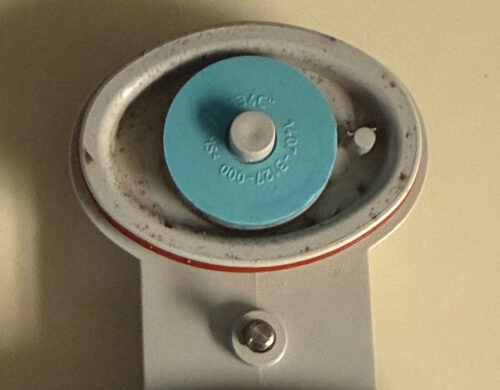
To the Editor: An 11-year-old male was successfully induced for a cleft palate repair. After insertion of the endotracheal tube, a marked change in pulmonary compliance was noted. The endotracheal tube was replaced on 2 separate occasions and albuterol was administered because of a presumptive diagnosis of bronchospastic disease. When none of these therapeutic interventions were successful in ameliorating the change in compliance, a careful inspection of the anesthesia circuit was then conducted. This inspection revealed a partial obstruction from a Luer adaptor that was designed to fit over the carbon dioxide sampling port. This Luer adaptor had been impacted in the elbow of the circuit. This occurred because of a process deficiency during the reprocessing of the anesthesia circuit. It should be noted that the hospital had decided to utilize a pasteurization process for reusing anesthesia circuit tubing and bags as a cost-containing measure. The obstruction in the elbow of the anesthesia circuit was not detected because the automated anesthesia machine checkout process for the Datex Ohmeda unit was proximal to the circuit elbow. Fortunately, the partial obstruction in the anesthesia circuit was discovered in a timely fashion, and an untoward patient outcome was averted. Institutions considering changing from a disposable circuit to a reusable (pasteurization) process need to be sure that the reprocessing procedure assures that no pieces of equipment are inappropriately placed in the anesthesia circuit. |
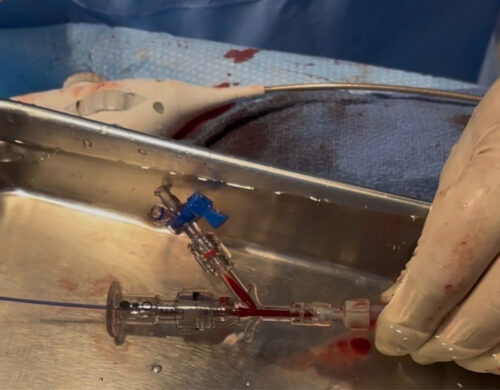
End-on view of the Luer adaptor wedged into the elbow of the anesthesia circuit. |
Side view of the Luer adaptor wedged into the elbow of the anesthesia circuit. |
|
|
|
To the Editor: Oblique Risks of Anesthesia back to top If we take a few steps back from the anesthesia machine, maybe all of the way back to the staff lounge so we can get a good look at our patient care setting—and we thoroughly survey our work environment—I believe that there exists an area of gross neglect, which poses a potential risk to the general population of our post 9/11 world. A risk, I believe, which we can do a better job of decreasing. Although we all practice in settings accredited by the JCAHO, AAAHC, and AAAASF,* which have “standards” applying to the secure storage and dispensation of medications (e.g., narcotics), we would probably all recognize huge safety gaps in this category of our daily operations. Narcotics may be kept in double lock boxes; however, other drugs, such as succinylcholine, can be accessed from multiple refrigerators and anesthesia carts from the ICU to the ambulatory surgery center. During normal working hours, succinylcholine and other medications are simply not kept under lock and key. As we know, just 5 ml of succinylcholine (in the wrong hands) given intramuscularly to a 70-kg individual on the street, is lethal. I would like to see a dialogue on the merits of various improved/strengthened anesthesiology standards that would keep better tabs on the dangerous drugs used in our profession every day. I see 2 ways in which we can improve. First, we could keep more dangerous (or potentially misused), non-narcotic medications in fewer, centralized locations that would be under some form of electronic surveillance at all times. Second, we should encourage standards that would require computer tracking chips (such as those currently used in grocery and hardware stores) to be placed inside medication vials/ampoules so that the medication could be tracked—from shipment at the factory to delivery at the bedside. These suggestions could not only decrease theft and waste, but also provide a more secure “system” within which we practice our trade. Terrorism and injury to innocent people may be just as great a threat on the smaller scale of health care institutions, as they are in the larger arenas of mass public gatherings and weapons of mass destruction. * JCAHO = Joint Commission on Accreditation of Healthcare Organizations, AAAHC = The Accreditation Association for Ambulatory Health Care, AAAASF = The American Association for Accreditation of Ambulatory Surgery Facilities. |
|
To the Editor: Woodward Maneuver Advocated For Treatment of Cardiac Arrest back to top Cardiac arrest during spinal anesthesia with the resultant severe to lethal neurologic injury was highlighted by Caplan in his 1988 review of closed malpractice insurance claims.1 Preemptive treatment as well as pharmacologic arrest protocols have been put forth, but none address one basic physiological aspect of the heart: The heart is a non-sucking pump (i.e., myocardial relaxation coupled with central venous pressure allows for passive filling of the heart).2 During cardiac arrest while the patient is under axial anesthesia, no matter how vigorously the closed chest is massaged, the cardiac output will not be enough to sustain perfusion to the brain. In addition, with the arterial vascular system dilated distal to the sympathetic block, one would surmise a preferential perfusion to the lower body in spite of CNS auto regulation. In 1952, a Tasmanian orthopedic surgeon described a case in which a 4-year-old boy in surgery for fractures of the hand unexpectedly developed cardiac arrest. He was initially unable to establish normal cardiac rhythm. As was the custom at the time, he performed open chest cardiac massage. He describes the heart as being “small and empty,” and his manual compressions of the heart were not effective in circulating blood. He immediately had the legs elevated vertically and felt the volume of the heart double almost instantly. It also began to beat spontaneously. He continued by wrapping the legs from foot to hip with Esmarch bandages.3 Woodward subsequently published 4 additional case reports in which cardiac arrest was successfully treated by elevating the legs.4 Elevating the legs has 2 functions. First, it functions to restore preload to the heart, facilitating closed chest massage, and secondly, it increases flow resistance to these areas possibly providing less of a steal from CNS perfusion. The Woodward maneuver is a simple means of generating cardiac preload as well as some increase in peripheral vascular resistance. Once circulation has ceased, bombardment with pharmacology will be ineffective without some means of circulation. We suggest that if preventative strategies fail to avert a cardiac arrest that the first line of defense be the Woodward maneuver.
|
|
To the Editor: Reader Extremely Tired of Fatigue back to top It has always perturbed me that for the 20 years I’ve been a practicing anesthesiologist not once have I seen guidelines for work hours for anesthesia providers. We all know too well the regulations imposed for airline pilots, truck drivers, nuclear plant workers, and even for residents-in-training for whom the new policy on work hours started in New York State. These guidelines are not baseless. There are innumerable studies by the military and articles in our own journals that dissect the effect of fatigue and long hours on the type of work that we do. That work that I am talking about is work that requires our utmost vigilance on a second-by-second basis. Working 12-14 hours a day or more and having to come back and start the whole process over again not only is detrimental to our health, but even worse for our patients. It is common sense that whatever hinders our work will eventually affect the patient. Why the resistance to setting up guidelines for practicing anesthesiologists? Are there not guidelines for drug abuse among physicians? Are there not guidelines on how we should conduct ourselves in a manner which benefits the patient at all times? Then why the resistance to mentioning, specifically, the role fatigue plays on our performance? I just do not understand. In my community, anesthesiologists are working long hours and keep going at the same pace without relief. I am not sure that many weeks of vacation is an answer. Vacation just gives temporary relief, not a change in “workstyle.” We talk so much about lifestyle, but we should focus on “workstyle.” This subject has come up in Anesthesiology,1 Anesthesiology News, and in the Anesthesia Malpractice Prevention Newsletter. So this isn’t a subject that hasn’t been dealt with, and our specialty needs to set the tone and document some guidelines. I know I am not the only one who feels strongly about this issue, as I have seen many letters to the editor in various journals. I just hope that some day our leadership, whom I respect so much, will wake up to the issue of fatigue.
|
|
To the Editor: Etiology of Hypoxemia Often Overlooked back to top I was struck by a seeming dichotomy in two sections of the Winter 2003-04 APSF Newsletter, the columns on postoperative hypoxemia vs. the current HRO initiatives. To a critical care physician, it is readily apparent that in most clinical settings, it is not the what that is important, but the why. I can imagine few things more fundamental to accomplishing the goals of HRO than a thorough understanding of the physiologic mechanisms underlying any clinical scenario. Hypoxemia may be the best example, for the following reasoning: Hypoxemia, itself, is virtually benign medically. Rather, in almost all clinical scenarios, it is not the specific pO2 of a patient that is important, but rather, why the pO2 is what it is. In Murphy and Vender's article reviewing the 2003 ASA scientific papers, they discuss a paper regarding postoperative hypoxemia. In this review, they note the cause (intensive opiate analgesia), but focus on the hypoxemia without noting that the real problem is the ventilatory defect. This is more than just semantics. Frequently, clinicians pay more attention to hypoxemia, thinking it deleterious; therefore they apply oxygen, without an understanding that it's not the secondary hypoxemia that will hurt the patient, but the primary defect (ventilatory or pulmonary parenchymal) that really needs to be addressed to “save” the patient. In similar fashion, the ASA’s Practice Guidelines for Sedation and Analgesia by Non-Anesthesiologists are remarkable for underemphasizing the importance of breathing. The guidelines even state, “If hypoxemia develops during sedation/analgesia, supplemental oxygen should be administered.” In my experience, such a concept is a recipe for respiratory arrest. It is a common occurrence in the ICU to review a chart of a newly intubated patient from the floor who has hypoxemia documented in their chart, followed by the application of oxygen, without sufficient (or any) investigation of the cause of the hypoxemia. In the case of the above, I would suggest that during sedation/analgesia, if hypoxemia develops, the first and foremost emphasis should be immediate determination of the cause of the hypoxemia. If the patient's physical breathing appears adequate and the airway is determined to be patent, then the procedure can be continued with oxygen supplementation. In fact, the entire 14-page guideline document could arguably have been summarized by one short sentence: BREATHING (via a patent airway) IS THE ONLY THING THAT COUNTS. In short, hypoxemia is virtually always a secondary issue, a simple but highly important signal that something is wrong. In terms of patient safety, the focus on hypoxemia itself, and consideration of it as harmful, is misplaced, and may even be injurious to the patient by distracting the clinician from a focus on the primary clinical problem, which may or may not be apparent. Subsequent application of oxygen may be doubly dangerous by raising the SpO2, thereby masking, often temporarily, the underlying pathology. Not that oxygen should not be applied when the SpO2 reaches some low level, but dogged attention must not be diverted from determining and addressing the cause of the hypoxemia. Specifically, in many settings, practitioners use the pulse oximeter as the de facto monitor of adequacy of ventilation, without realizing that they are doing so. By my observation, this includes many who are not anesthesia providers, yet practice sedation, along with nurses in the recovery room and ICU, and even during monitored anesthesia care. These individuals may fail to understand that only if the patient breathes room air does the SpO2 correlate closely with alveolar ventilation (with only a lag of a few breaths). Once added inspired oxygen is applied, even one or two liters by nasal cannulae, the patient is moved to the right on the Hb-oxygen dissociation curve, and the pO2 no longer linearly correlates with the SpO2; the SpO2 therefore no longer correlates with alveolar ventilation. In fact, the higher the percentage of inspired oxygen, the less the SpO2 moves with even large changes in pO2, and therefore pCO2—all the way up to apneic oxygenation. Thus, the use of oxygen may mask the onset and delay the recognition of inadequate ventilation, apnea, and/or airway obstruction, as detected by pulse oximetry. Accordingly, probably the best way for the non-anesthesia provider to stay out of trouble during IV sedation is to titrate drugs slowly to a patient breathing room air. The decline in SpO2 to the point of the practitioner's comfort would thus preclude further administration of drug doses or combinations that would cause further hypoventilation or apnea. (Note that the level of induced hypoventilation directly reflects the degree of sedation; in turn, in a sedated patient breathing room air, the SpO2 correlates with the ventilatory status. Thus, in such a patient the SpO2 offers an indirect but quantitative measure of the patient’s level of sedation, and as a practical matter, sedative administration can therefore be titrated to the SpO2, but only if the patient is breathing room air.) For those who have any doubt about the benign consequences of hypoxemia itself, the following reports and case histories from anesthesiologists and critical care physicians from around the world who participate in the GasNet and CCM-L web-discussion groups are presented for consideration:
Proof of lack of detriment does exist. There have been studies in thousands of patients showing that when anesthesiologists are not aware of the SpO2, moderate levels of hypoxemia (i.e., SpO2s in the 80s) occur commonly, with no adverse effect to patients.1,2 From the above and other studies, and from knowledge and insight gained since the advent of pulse oximetry in the OR, there can be little doubt that during the majority of years that anesthesiology has been practiced (i.e., from the mid 1800s to the mid-1980s), episodic undiagnosed hypoxemia was rampant, yet patients weren't dying, having myocardial infarctions, or stroking out by the hundreds, unless the hypoxemia was prolonged. The latter cases virtually always occurred as a result of a major ventilatory problem, recognized or not (in particular, unrecognized esophageal intubation, apnea, or airway obstruction). There is no consistent evidence, even in patients with stable coronary artery disease, that low levels of acute hypoxemia (or even chronic hypoxemia in some settings) are, in themselves, dangerous. On the contrary, there is much anecdotal evidence of no harm coming to such patients. Evidence from the years previous to the development of the pulse oximeter would overwhelmingly corroborate that. What is potentially dangerous are the reasons for which the SpO2 drops acutely in acute care settings. Finally, “A Focus on History” (ASA Newsletter September 2001) states: “Inhalation anesthesia of the early 1920s consisted of either breathing anesthetic gases and vapors via a mask and bag or by open-drop of volatile liquids (ether or chloroform) on a gauze mask. There were no intravenous agents to speed induction. One hundred percent nitrous oxide was administered for gas induction and attainment of maximum anesthesia. Induction was usually accomplished within 2 to 3 minutes and was followed by addition of 10 percent to 15 percent oxygen, or more, to avoid cyanosis. ‘Too much oxygen’ was shunned to avoid diluting the nitrous oxide .”
Editor’s Note: While this letter makes several valid and important points, it is important to NOT withhold supplemental oxygen from those patients for whom it is indicated by clinical judgment. The APSF Newsletter invites readers’ thoughts and comments on this topic. |
|
To the Editor: GrafikPharm: Viewing the APSF From An Outside Perspective back to top Our graphic design company has been working on the APSF Newsletter since the Winter Issue of 1998. We design the electronic layout, prep the photos and files for printing, and coordinate the printing and mailing of the Newsletter. GrafikPharm is located in Wilmington, Delaware, and we service many medical, pharmaceutical, and biotech clients. Originally we were recommended for this project by Bob Black and Marilyn Brown of AstraZeneca. Dr. John Eichhorn was the APSF Newsletter Editor at that time. Through the years we have developed a close working relationship with both editors, Dr. Eichhorn and now Dr. Robert Morell, and have gently and gradually guided the Newsletter toward electronic proofing, and recently, a new full color format. As the person who usually works on the newsletter, I see the articles that come in—the ones that are used and the ones that are temporarily shelved—and from an “outsider” point of view, I am constantly impressed by this unbiased and ethical view of the state of your industry. The APSF Newsletter serves as a wonderful forum for discussion. Controversy is enthusiastically welcomed (even when it concerns major contributors to the Newsletter, and even when it highlights some pretty unsavory things—like the person who took a 2-week course in liposuction and was anesthetizing people and operating in a Texas mall—that one really stuck with me). Both sides of issues are explored (see the new Dear SIRS column to see what I mean). Timely and vital information is distributed, especially the special Bioterrorism issue, the SARS issue, and the recent High Reliability Organization articles (all available on your website). As a community, you police yourselves, you keep on top of timely issues, you don’t shy away from the tough stuff, and we applaud you. We have a great deal of respect for the intent and philosophy of this organization and we appreciate the opportunity to dedicate our skills to helping you. |
APSF Newsletter. |